

This is a collection of very old dessert or sweet pie recipes intended for serving as pudding or dessert. Most of these recipes are from the Edwardian, Victorian, Georgian, & Stuart Eras but were probably in existence for at least a century before that. I will be adding even older historical pie recipes in due course.
You can use shop-bought puff pastry or shortcrust pastry for these recipes if you do not wish to prepare your own at home. It can be so much fun recreating old Victorian, recipes in modern times. Since these recipes used everyday ingredients, it can be very budget-friendly to use old recipes.
Do let us know if you bake one of these pies. I will be trying out some of the recipes and will post a photo and a few comments, under the particular recipe, in case that may be useful for you!
If you are looking for a particular recipe for an old dessert pie, do ask, and I will do my best to scour the old recipe books to find it.
Table of Contents
- A HANDBOOK OF COOKERY FOR A SMALL HOUSE BY JESSIE CONRAD [1923]
- The Healthy Life Cook Book by Florence Daniel [Second Edition, 1915]
- Victorian Dessert Pie Recipes from Fast Day Cookery or Meals Without Meat by Grace Johnston [1893]
- MODERN COOKERY FOR PRIVATE FAMILIES (New Edition) by ELIZA ACTON [1882]
- CREAM CRUST. (Authors Receipt. Very good.)
- VERY RICH SHORT CRUST FOR TARTS.
- EXCELLENT SHORT CRUST FOR SWEET PASTRY.
- BRIOCHE PASTE.
- RECEIPT FOR TARTLETS.
- APPLE CAKE, OR GERMAN TART.
- TOURTE MERINGUÉE, OR TART WITH ROYAL ICING.
- A GOOD APPLE TART.
- TART OF VERY YOUNG GREEN APPLES. (GOOD.)
- BARBERRY TART.
- THE LADY’S TOURTE, AND CHRISTMAS TOURTE À LA CHÂTELAINE.
- ALMOND PASTE.
- TARTLETS OF ALMOND PASTE.
- FAIRY FANCIES.
- MINCE PIES.
- MINCE PIES ROYAL.
- THE MONITOR’S TART, OR TOURTE À LA JUDD.
- PUDDING PIES. [Kentish]
- PUDDING PIES. (A commoner kind.)
- COMMON LEMON TARTLETS.
- PASTRY SANDWICHES.
- FANCHONNETTES.
- JELLY TARTLETS, OR CUSTARDS.
- STRAWBERRY TARTLETS. (GOOD.)
- RASPBERRY PUFFS.
- CREAMED TARTLETS.
- CRÊME PATISSIÈRE, OR PASTRY CREAM.
- Victorian Pastry recipes for Sweet Pies from Mrs Beeton’s Book of Household Management [1861]
- VERY GOOD PUFF-PASTE.
- MEDIUM PUFF-PASTE.
- VERY GOOD SHORT CRUST FOR FRUIT TARTS.
- ANOTHER GOOD SHORT CRUST.
- COMMON SHORT CRUST.
- To ice or glaze pastry
- Victorian Dessert Pie Recipes from Mrs Beeton’s Book of Household Management [1861]
- APPLE TART OR PIE.
- CREAMED APPLE TART.
- APRICOT TART.
- BARBERRY TART.
- CHERRY TART.
- RED-CURRANT AND RASPBERRY TART.
- DAMSON TART.
- FOLKESTONE PUDDING-PIES.
- FRUIT TURNOVERS (suitable for Pic-Nics).
- GOOSEBERRY TART.
- MINCE PIES.
- PASTRY SANDWICHES.
- PLUM TART.
- RHUBARB TART.
- OPEN TART OF STRAWBERRY OR ANY OTHER KIND OF PRESERVE.
- TARTLETS. [Jam Tarts]
- SWEET VOL-AU-VENT OF PLUMS, APPLES, OR ANY OTHER FRESH FRUIT.
- VOL-AU-VENT OF FRESH STRAWBERRIES WITH WHIPPED CREAM.
- FLAN OF APPLES, or APPLES IN A RAISED CRUST.
- The Lady’s Own Cookery Book, And New Dinner-Table Directory; In which will be found A LARGE COLLECTION OF ORIGINAL RECEIPTS, Including not only THE RESULT OF THE AUTHERESS’S MANY YEARS OBSERVATION, EXPERIENCE, AND RESEARCH, but also the CONTRIBUTIONS OF AN EXTENSIVE CIRCLE OF ACQUAINTANCE: Adapted to the use of PERSONS LIVING IN THE HIGHEST STYLE, as well as those of MODERATE FORTUNE. [1844]
- Georgian Pie Recipes from The Art of Cookery Made Easy and Refined By John Mollard, Cook, [1802]
- Stuart Era Pie Recipes from The Accomplisht Cook, or The Art & Mystery of Cookery [1685]
- To make a Pumpion Pie. [pumpkin]
- To make a Pippin Pye. [apple pie]
- To make a Pippin Tart, either in Tart, Patty-Pan, or Dish.
- A made Dish of Pippins.
- To preserve Pippins [apples] in slices.
- To make a Warden or a Pear Tart quartered.
- Other Tart of Warden, Quinces, or Pears.
- To make a Tart of Hips. [Rose Hips]
- To make a Tart of Rice.
- To make a tart of Medlers.
- To make a Cherry-Tart.
- To make a Strawberry-Tart.
- To make a Taffety-Tart.
- To make an Almond Tart.
- To make a Damson Tart.
- To make Cream Tarts.
- To make a French Tart.
- To make a Quodling Pie. [Apple]
- To make a Dish in the Italian Fashion.
- For the several Colours of Tarts.
- Tart stuff of damsons. [plums]
- Other Tart stuff that carries its colour black.
- To make other black Tart Stuff.
- Yellow Tart Stuff.
- White Tart-Stuff.
- Green Tart-Stuff.
- To bake Apricocks green. [Apricots]
- To bake Mellacattons. [Peaches]
A HANDBOOK OF COOKERY FOR A SMALL HOUSE BY JESSIE CONRAD [1923]
General Remarks
For Tarts the fruit of all kinds must always be cooked first by itself.
Bottled fruits should also be brought to a boil with sugar before being put into the pastry, except for baked apple dumplings.
Pastry for Pies and Tarts
Three breakfast-cupfuls of self-raising flour, a quarter of a pound of fresh butter, and two ounces of lard. Work the butter and lard into the flour with a good pinch of salt and mix to a smooth elastic paste with milk (sour milk may be used with advantage). Roll the paste on the board about half an inch thick. Rub a little butter lightly round the rim of the dish and put a border of paste round it.
Brush a little milk on the top of that to allow the other crust to stick to it. Roll out an amount of paste sufficient to form a crust over the top, press the edges well together, allowing plenty of room in the paste so that it does not slip off at the edges.
Pare with a floured knife round the rim the edges of the pastry and cook for three quarters of an hour in a brisk oven.
Plums or Damsons for a Tart or as Stewed Fruit
Carefully look over one pound of plums or damsons, removing any unsound ones. Put them into an earthenware saucepan with a teacupful of cold water and two teacupfuls of sugar to the plums or three teacupfuls to the damsons. Stew for one hour the damsons, or forty minutes the plums.
Stewed Gooseberries [for a pie]
Carefully pick a quart of gooseberries, discarding the unsound ones. Put them into an earthenware saucepan with a teacupful of cold water and three teacupfuls of sugar. Boil for about an hour, stirring now and then to prevent them from burning. Serve either as stewed fruit or for a pie.
Stewed Rhubarb [for a pie]
Remove the leaves and cut the other end of the rhubarb crosswise and skin it. Cut it into pieces of about two inches long. Put it into a saucepan (either earthenware or enamelled) and allow a small teacupful of sugar to each three or four sticks of rhubarb. Add half a teacupful of water, put over a brisk fire for forty minutes, when the rhubarb should attain a rich red colour. This can be used either as stewed rhubarb or put into a pie.
Apple Tart
Take about six apples and pare finely. Do not core them but cut them in slices round the core. Put a teacupful of powdered sugar in a stone saucepan. Add a very little cold water. Stew gently for half an hour to three-quarters and turn into a pie-dish. Pastry as recipe below. Fresh fruit is always better cooked first before putting into the pastry.
Jam Tarts
A breakfast-cupful and a half of self-raising flour, three ounces of fresh butter, a well-beaten egg, and a little salt. Mix these ingredients with milk into a stiff paste. Roll it very thin and have ready a plate greased with hot butter and when cool lay a thin layer of pastry on the plate, rub a little milk round the rim and spread the jam over it not too thick.
Cut some pastry in thin strips and lay across like the spokes of a wheel. Bake in a quick oven for twenty minutes. Be careful the jam is not too juicy.
The Healthy Life Cook Book by Florence Daniel [Second Edition, 1915]
FRUIT NUT FILLING.
For small, open tarts, the following mixture is a good substitute for the lemon curd that goes to make cheese cakes. Peel, core and quarter some juicy apples. Put in a double saucepan (or covered jar) with some strips of lemon peel (yellow part only) and cane sugar to taste. Cook slowly to a pulp and, when cold, remove the lemon rind. Grate finely, or mill some Brazil nuts. Mix apple pulp and ground nut together in such proportions as to make a mixture of the consistency of stiff jam. Fill tarts with mixture and sprinkle top with ground nut. It must be used the same day as made.
APPLE SANDWICH.
Make a short crust (see recipe). Well grease some shallow jam sandwich tins. Roll out the paste very thin and line with it the tins. Peel, core, and finely chop some good, juicy apples. Spread well all over the paste. Sprinkle with castor sugar and grated lemon rind. Cover with another layer of thin paste. Bake for about 20 minutes in a hot oven. When done, take carefully out of the tin to cool. Cut into wedges, sprinkle with castor sugar, and pile on a plate.
APPLE DUMPLINGS. [whole apples baked or boiled with a short crust pastry jacket]
Peel and core some good cooking apples, but keep them whole. If you have no apple-corer, take out as much of the core as possible with a pointed knife-blade. Fill the hole with sugar and a clove.
Make short paste [see recipe below] and cut into squares. Fold neatly round and over apple. Bake from 30 to 45 minutes.
If preferred boiled, tie each dumpling loosely in a cloth, put into boiling water and cook from 45 minutes to 1 hour.
SHORT CRUST.
1/2 lb. flour, 3 ozs. nutter or butter.
Rub the nutter or butter lightly into the flour. Add enough cold water to make a fairly stiff paste. Roll it out to a 1/4 inch thickness. It is now ready for use.
PUFF PASTE.
1/2 lb. fresh-butter or 6 ozs. Mapleton’s nutter, 1 yolk of egg or 1 teaspoon lemon juice, 1/2 lb. flour.
If butter is used, wrap it in a clean cloth and squeeze well to get rid of water. Beat the yolk of egg slightly. Put the flour on the paste board in a heap. Make a hole in the centre and put in the yolk of egg or lemon juice, and about 1 tablespoon of water. The amount of water will vary slightly according to the kind of flour, and less will be required if egg is used instead of lemon juice, but add enough to make a rather stiff paste. Mix lightly with the fingers and knead until the paste is nice and workable. But do it quickly!
Next, roll out the paste to about 1/4 inch thickness. Put all the butter or nutter in the centre of this paste and wrap it up neatly therein. Stand in a cool place for 15 minutes. Next, roll it out once, and fold it over, roll it out again and fold it over. Do this lightly. Put it away again for 15 minutes. Repeat this seven times! (I do not think many food-reformers will have the time or inclination to repeat the above performance often. Speaking for myself, I have only done it once. But as no instructions about pastry are supposed to be complete without a recipe for puff-paste, I include it.) It is now ready for use.
Do not forget to keep the board and pin well floured, or the pastry will stick. If wholemeal flour is used, it is well to have white flour for the board and pin. See also that the nutter is the same consistency as ordinary butter when kept in a medium temperature. If too hard, it must be cut up and slightly warmed. If oily, it must be cooled by standing tin in very cold water.
Victorian Dessert Pie Recipes from Fast Day Cookery or Meals Without Meat by Grace Johnston [1893]
Currant and Apple Tart.
Make a nice short crust of Coombs’ Eureka Flour, thus—half a pound of flour, three ounces of butter, one egg well beaten, a pinch of salt, and one teaspoon of castor sugar. Make it into a nice dough with milk. Put in a pie dish one layer of dry currants well washed and picked, a little grated lemon peel, and a few drops of lemon juice, then a spoonful of treacle and a few very fine bread crumbs, then a layer of sliced fresh apples, and again the currants, and so on till the dish is full. Cover with the paste rolled thin, and ornament prettily on the top with the paste nicely cut out, etc., etc. Bake a nice golden brown, and when a little cool sprinkle castor sugar over the top. Serve with a nice custard or cream.
Pumpkin Tart.
Make a puff paste of Coombs’ Eureka Flour, and line a nice sized shallow tin pan with it. Grease the pan well; prick the paste to prevent it blistering; bake a nice colour and turn out of the pan. Fill up with a mixture made thus—boil one pound of nice ripe yellow pumpkin till soft; pass it through a sieve. Add to it half a pound of sugar, the grated rind of a small lemon, the strained juice of a lemon, the strained juice of an orange, a few cloves. Boil till it looks nice and clear; take out the cloves, and fill the mixture into the paste case. Cover over neatly with well whipped cream, and sprinkle over the top some chopped pistachio nuts.
MODERN COOKERY FOR PRIVATE FAMILIES (New Edition) by ELIZA ACTON [1882]
TO GLAZE OR ICE PASTRY
The best mode of icing fruit-tarts before they are sent to the oven is, to moisten the paste with cold water, to sift sugar thickly upon it, and to press it lightly on with the hand; but when a whiter icing is preferred, the pastry must be drawn from the oven when nearly baked, and brushed with white of egg, wisked to a froth; then well covered with the sifted sugar, and sprinkled with a few drops of water before it is put in again: this glazing answers also very well, though it takes a slight colour, if used before the pastry is baked.
CREAM CRUST. (Authors Receipt. Very good.)
Stir a little fine salt into a pound of dry flour, and mix gradually with it sufficient very thick, sweet cream to form a smooth paste; it will be found sufficiently good for common family dinners, without the addition of butter; but to make an excellent crust, roll in four ounces in the usual way, after having given the paste a couple of turns. Handle it as lightly as possible in making it, and send it to the oven as soon as it is ready: it may be used for fruit tarts, cannelons, puffs, and other varieties of small pastry, or for good meat pies. Six ounces of butter to the pound of flour will give a very rich crust.
Flour, 1 lb.; salt, 1 small saltspoonful (more for meat pies); rich cream, 1/2 to 3/4 pint; butter, 4 oz.; for richest crust, 6 oz.
VERY RICH SHORT CRUST FOR TARTS.
Break lightly, with the least possible handling, six ounces of butter into eight of flour; add a dessertspoonful of pounded sugar, and two or three of water; roll the paste, for several minutes, to blend the ingredients well, folding it together like puff-crust, and touch it as little as possible.
Flour, 8 oz.; butter, 6 oz.; pounded sugar, 1 dessertspoonful; water, 1 to 2 spoonsful.
EXCELLENT SHORT CRUST FOR SWEET PASTRY.
Crumble down very lightly half a pound of butter into a pound of flour, breaking it quite small. Mix well with these a slight pinch of salt and two ounces of sifted sugar, and add sufficient milk to make them up into a very smooth and somewhat firm paste. Bake this slowly, and keep it pale. It will be found an admirable crust if well made and lightly handled, and will answer for many dishes much better than puff-paste. It will rise in the oven too, and be extremely light. Ten ounces of butter will render it very rich, but we find eight quite sufficient.
BRIOCHE PASTE.
The brioche is a rich, light kind of unsweetened bun or cake, very commonly sold, and served to all classes of people in France, where it is made in great perfection by good cooks and pastry cooks. It is fashionable now at English tables, though in a different form, serving principally as a crust to enclose rissoles, or to make cannelons and fritters.
We have seen it recommended for a vol-au-vent, for which we should say it does not answer by any means so well as the fine puff-paste called feuilletage. The large proportion of butter and eggs which it contains render it to many persons highly indigestible; and we mention this to warn invalids against it, as we have known it to cause great suffering to persons out of health. To make it, take a couple of pounds[114] of fine dry flour, sifted as for cakes, and separate eight ounces of this from the remainder to make the leaven.
Put it into a small pan, and mix it lightly into a lithe paste, with half an ounce of yeast, and a spoonful or two of warm water; make two or three slight incisions across the top, throw a cloth over the pan, and place it near the fire for about twenty minutes to rise. In the interval make a hollow space in the centre of the remainder of the flour, and put into it half an ounce of salt, as much fine sifted sugar, and half a gill of cream, or a dessertspoonful of water; add a pound of butter as free from moisture as it can be, and quite so from large grains of salt; cut it into small bits, put it into the flour, and pour on it one by one six fresh eggs freed from the specks; then with the fingers work the flour gently into this mass until the whole forms a perfectly smooth, and not stiff paste: a seventh egg, or the yolk of one, or even of two, may be added with advantage if the flour will absorb them; but the brioche must always be workable, and not so moist as to adhere to the board and roller disagreeably.
When the leaven is well risen spread this paste out, and the leaven over it; mix them well together with the hands, then cut the whole into several portions, and change them about that the leaven may be incorporated perfectly and equally with the other ingredients: when this is done, and the brioche is perfectly smooth and pliable, dust some flour on a cloth, roll the brioche in it, and lay it into a pan. Place it in summer in a cool place, in winter in a warm one. It is usually made over-night, and baked in the early part of the following day. It should then be kneaded up afresh the first thing in the morning.
To mould it in the usual form, make it into balls of uniform size, hollow these a little at the top by pressing the thumb round them, brush them over with yolk of egg, and put a second much smaller ball into the hollow part of each; glaze them entirely with yolk of egg, and send them to a quick oven for half an hour or more.
The paste may also be made into the form of a large cake, then placed on a tin, or copper oven-leaf, and supported with a pasteboard in the baking.
114. It should be remarked, that the directions for brioche-making are principally derived from the French, and that the pound in their country weighs two ounces more than with us: this difference will account for the difficulty of working in the number of eggs which they generally specify, and which render the paste too moist.
Flour, 2 lbs.; yeast, 1/2 oz.; salt and sugar, each 1/2 oz.; butter, 1 lb.; eggs, 6 to 8.
RECEIPT FOR TARTLETS.
For a dozen tartlets, cut twenty-four rounds of paste of the usual size, and form twelve of them into rings by pressing the small cutter quite through them; moisten these with cold water, or white of egg, and lay them on the remainder of the rounds of paste, so as to form the rims of the tartlets.
Bake them from ten to twelve minutes, fill them with preserve while they are still warm, and place over it a small ornament of paste cut from the remnants, and baked gently of a light colour. Serve the tartlets cold, or if wanted hot for table put them back into the oven for one minute after they are filled.
APPLE CAKE, OR GERMAN TART.
Work together with the fingers, ten ounces of butter and a pound of flour, until they resemble fine crumbs of bread; throw in a small pinch of salt, and make them into a firm smooth paste with the yolks of two eggs and a spoonful or two of water. Butter thickly, a plain tin cake, or pie mould (those which open at the sides); roll out the paste thin, place the mould upon it, trim a bit to its exact size, cover the bottom of the mould with this, then cut a band the height of the sides, and press it smoothly round them, joining the edge, which must be moistened with egg or water, to the bottom crust; and fasten upon them, to prevent their separation, a narrow and thin band of paste, also moistened.
Next, fill the mould nearly from the brim with the following marmalade, which must be quite cold when it is put in. Boil together, over a gentle fire at first, but more quickly afterwards, three pounds of good apples with fourteen ounces of pounded sugar, or of the finest Lisbon, the strained juice of a large lemon, three ounces of fresh butter, and a teaspoonful of pounded cinnamon, or the lightly grated rind of a couple of lemons: when the whole is perfectly smooth and dry, turn it into a pan to cool, and let it be quite cold before it is put into the paste. In early autumn, a larger proportion of sugar may be required, but this can be regulated by the taste. When the mould is filled, roll out the cover, lay it carefully over the marmalade that it may not touch it; and when the cake is securely closed, trim off the superfluous paste, add a little pounded sugar to the parings, spread them out very thin, and cut them into leaves to ornament the top of the cake, round which they may be placed as a sort of wreath.[121]
Bake it for an hour in a moderately brisk oven; take it from the mould, and should the sides not be sufficiently coloured put it back for a few minutes into the oven upon a baking tin. Lay a paper over the top, when it is of a fine light brown, to prevent its being too deeply coloured. This cake should be served hot.
121. Or, instead of these, fasten on it with a little white of egg, after it is taken from the oven, some ready-baked leaves of almond-paste, either plain or coloured.
Paste: flour, 1 lb.; butter, 10 oz.; yolks of eggs, 2; little water. Marmalade: apples, 3 lbs.; sugar, 14 oz. (more if needed); juice of lemon, 1; rinds of lemons, 2; butter, 3 oz.: baked, 1 hour.
TOURTE MERINGUÉE, OR TART WITH ROYAL ICING.
The limits to which we are obliged to confine this volume, compel us to omit many receipts which we would gladly insert; we have, therefore, rejected those which may be found in almost every English cookery book, for such as are, we apprehend, less known to the reader: this will account for the small number of receipts for pies and fruit tarts to be found in the present chapter.
Lay a band of fine paste round the rim of a tart-dish, fill it with any kind of fruit mixed with a moderate proportion of sugar, roll out the cover very evenly, moisten the edges of the paste, press them together carefully, and trim them off close to the dish; spread equally over the top, to within rather more than an inch of the edge all round, the whites of three fresh eggs beaten to a quite solid froth and mixed quickly at the moment of using them with three tablespoonsful of dry sifted sugar. Put the tart into a moderately brisk oven, and when the crust has risen well and the icing is set, either lay a sheet of writing-paper lightly over it, or draw it to a part of the oven where it will not take too much colour. This is now a fashionable mode of icing tarts, and greatly improves their appearance.
Bake half an hour.
A GOOD APPLE TART.
A pound and a quarter of apples weighed after they are pared and cored, will be sufficient for a small tart, and four ounces more for one of moderate size. Lay a border of English puff-paste, or of cream-crust round the dish, just dip the apples into water, arrange them very compactly in it, higher in the centre than at the sides, and strew amongst them from three to four ounces of pounded sugar, or more should they be very acid: the grated rind and the strained juice of half a lemon will much improve their flavour.
Lay on the cover rolled thin, and ice it or not at pleasure. Send the tart to a moderate oven for about half an hour. This may be converted into the old-fashioned creamed apple tart, by cutting out the cover while it is still quite hot, leaving only about an inch-wide border of paste round the edge, and pouring over the apples when they have become cold, from half to three-quarters of a pint of rich boiled custard.
The cover divided into triangular sippets, was formerly stuck round the inside of the tart, but ornamental leaves of pale puff-paste have a better effect. Well-drained whipped cream may be substituted for the custard, and be piled high, and lightly over the fruit.
TART OF VERY YOUNG GREEN APPLES. (GOOD.)
Take very young apples from the tree before the cores are formed, clear off the buds and stalks, wash them well, and fill a tart-dish with them after having rolled them in plenty of sugar, or strew layers of sugar between them; add a very small quantity of water and bake the tart rather slowly, that the fruit may be tender quite through. It will resemble a green apricot-tart if carefully made. We give this receipt from recollection, having had the dish served often formerly, and having found it very good.
BARBERRY TART.
Barberries, with half their weight of fine brown sugar, when they are thoroughly ripe, and with two ounces more when they are not quite so, make an admirable tart. For one of moderate size, put into a dish bordered with paste three quarters of a pound of barberries stripped from their stalks, and six ounces of sugar in alternate layers; pour over them three tablespoonsful of water, put on the cover, and bake the tart for half an hour. Another way of making it is, to line a shallow tin pan with very thin crust, to mix the fruit and sugar well together with a spoon before they are laid in, and to put bars of paste across instead of a cover; or it may be baked without either.[123]
123. The French make their fruit-tarts generally thus, in large shallow pans. Plums, split and stoned (or if of small kinds, left entire), cherries and currants freed from the stalks, and various other fruits, all rolled in plenty of sugar, are baked in the uncovered crust; or this is baked by itself, and then filled afterwards with fruit previously stewed tender.
THE LADY’S TOURTE, AND CHRISTMAS TOURTE À LA CHÂTELAINE.
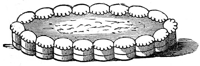
Lady’s Tourte.
To make this Tourte, which, when filled, is of pretty appearance, two paste-cutters are requisite, one the size, or nearly so, of the inside of the dish in which the entremets is to be served, the other not more than an inch in diameter, and both of them fluted, as will be seen by the engraving. To make the paste for it, throw a small half saltspoonful of salt into half a pound of the finest flour, and break lightly into it four ounces of fresh butter, which should be firm. Make these up smoothly with cold milk or water, of which nearly a quarter of a pint will be sufficient, unless the butter should be very hard, when a spoonful or two more must be added. Roll the paste out as lightly as possible twice or thrice if needful, to blend the butter thoroughly with it, and each time either fold it in three by wrapping the ends over each other, or fold it over and over like a roll pudding. An additional ounce, or even two, of butter can be used for it when very rich pastry is liked, but the tourte will not then retain its form so well.
Roll it out evenly to something more than three-quarters of an inch in thickness, and press the large cutter firmly through it; draw away the superfluous paste, and lay the tourte on a lightly floured baking-tin. Roll the remainder of the paste until it is less than a quarter of an inch thick, and stamp out with the smaller cutter—of which the edge should be dipped into hot water, or slightly encrusted with flour—as many rounds as will form the border of the tourte. In placing them upon it, lay the edge of one over the other just sufficiently to give a shell-like appearance to the whole; and with the finger press lightly on the opposite part of the round to make it adhere to the under paste.
Next, with a sharp-pointed knife, make an incision very evenly round the inside of the tourte nearly close to the border, but be extremely careful not to cut too deeply into the paste. Bake it in a gentle oven, from twenty to thirty minutes.
When it is done, detach the crust from the centre, where it has been marked with the knife, take out part of the crumb, fill the space high with apricot-jam, or with any other choice preserve, set it again for an instant into the oven, and serve it hot or cold. Spikes of blanched almonds, filberts, or pistachio-nuts, may be strewed over the preserve, when they are considered an improvement; and the border of the pastry may be glazed or ornamented to the fancy; but if well made, it will generally please in its quite simple form.
It may be converted into a delicious entrée, by filling it either with oysters, or sliced sweetbreads, stewed, and served in thick, rich, white sauce, or béchamel. Lobster also prepared and moulded as for the new lobster patties, will form a superior dish even to these.
Obs.—Six ounces of flour, and three of butter, will make sufficient paste for this tourte, when it is required only of the usual moderate size. If richer paste be used for it, it must have two or three additional turns or rollings to prevent its losing its form in the oven.
Christmas Tourte à la Châtelaine.—Make the case for this tourte as for the preceding one, and put sufficient mincemeat to fill it handsomely into a jar, cover it very securely with paste, or with two or three folds of thick paper, and bake it gently for half an hour or longer, should the currants, raisins, &c., not be fully tender. Take out the inside of the tourte, heap the hot mincemeat in it, pour a little fresh brandy over; just touch it with a strip of lighted writing-paper at the door of the dining-room, and serve it in a blaze; or if better liked so, serve it very hot without the brandy, and with Devonshire cream as an accompaniment.[124]
124. Sufficient of cream for this purpose can easily be prepared from good milk.
ALMOND PASTE.
For a single dish of pastry, blanch seven ounces of fine Jordan almonds and one of bitter;[125] throw them into cold water as they are done, and let them remain in it for an hour or two; then wipe, and pound them to the finest paste, moistening them occasionally with a few drops of cold water, to prevent their oiling; next, add to, and mix thoroughly with them, seven ounces of highly-refined, dried, and sifted sugar; put them into a small preserving-pan, or enamelled stewpan, and stir them over a clear and very gentle fire until they are so dry as not to adhere to the finger when touched; turn the paste immediately into an earthen pan or jar, and when cold it will be ready for use.
125. When these are objected to, use half a pound of the sweet almonds.
Jordan almonds, 7 oz.; bitter almonds, 1 oz.; cold water, 1 tablespoonful; sugar, 7 oz.
Obs.—The pan in which the paste is dried, should by no means be placed upon the fire, but high above it on a bar or trevet: should it be allowed by accident to harden too much, it must be sprinkled plentifully with water, broken up quite small, and worked, as it warms, with a strong wooden spoon to a smooth paste again. We have found this method perfectly successful; but, if time will permit, it should be moistened some hours before it is again set over the fire.
TARTLETS OF ALMOND PASTE.
Butter slightly the smallest-sized pattypans, and line them with the almond-paste rolled as thin as possible; cut it with a sharp knife close to their edges, and bake or rather dry the tartlets slowly at the mouth of a very cool oven. If at all coloured, they should be only of the palest brown; but they will become perfectly crisp without losing their whiteness if left for some hours in a very gently-heated stove or oven.
They should be taken from the pans when two-thirds done, and laid, reversed, upon a sheet of paper placed on a dish or board, before they are put back into the oven. At the instant of serving, fill them with bright-coloured whipped cream, or with peach or apricot jam; if the preserve be used, lay over it a small star or other ornament cut from the same paste, and dried with the tartlets. Sifted sugar, instead of flour, must be dredged upon the board and roller in using almond paste.
Leaves and flowers formed of it, and dried gradually until perfectly crisp, will keep for a long time in a tin box or canister, and they form elegant decorations for pastry. When a fluted cutter the size of the pattypans is at hand, it will be an improvement to cut out the paste with it, and then to press it lightly into them, as it is rather apt to break when pared off with a knife. To colour it, prepared cochineal, or spinach-green, must be added to it in the mortar.
FAIRY FANCIES.
(Fantaisies de Fées.)
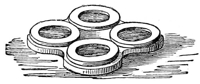
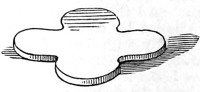
A small, but very inexpensive set of tin cutters must be had for this pretty form of pastry, which is, however, quite worthy of so slight a cost. The short crust, answers for it better than puff paste. Roll it thin and very even, and with the larger tin, shaped thus, cut out a dozen or more of small sheets; then, with a couple of round cutters, of which one should be about an inch in diameter, and the other only half the size, form four times the number of rings, and lay them on the sheets in the manner shown in the engraving. The easier mode of placing them regularly, is to raise each ring without removing the small cutter from it, to moisten it with a camel’s hair brush dipped in white of egg, and to lay it on the paste as it is gently loosened from the tin When all the pastry is prepared, set it into a very gentle oven, that it may become crisp and yet remain quite pale. Before it is sent to table, fill the four divisions of each fantaisie with preserve of a different colour. For example: one ring with apple or strawberry jelly, another with apricot jam, a third with peach or green-gage, and a fourth with raspberry jelly. The cases may be iced, and ornamented in various ways before they are baked. They are prettiest when formed of white almond-paste, with pink or pale green rings: they may then be filled, at the instant of serving, with well-drained whipped cream.
MINCE PIES.
(ENTREMETS.)
Butter some tin pattypans well, and line them evenly with fine puff paste rolled thin; fill them with mincemeat, moisten the edges of the covers, which should be nearly a quarter of an inch thick, close the pies carefully, trim off the superfluous paste, make a small aperture in the centre of the crust with a fork or the point of a knife, ice the pies or not, at pleasure, and bake them half an hour in a well-heated but not fierce oven: lay a paper over them when they are partially done, should they appear likely to take too much colour.
1/2 hour.
MINCE PIES ROYAL.
(ENTREMETS.)
Add to half a pound of good mincemeat an ounce and a half of pounded sugar, the grated rind and the strained juice of a large lemon, one ounce of clarified butter, and the yolks of four eggs; beat these well together, and half fill, or rather more, with the mixture, some pattypans lined with fine paste; put them into a moderate oven, and when the insides are just set, ice them thickly with the whites of the eggs beaten to snow, and mixed quickly at the moment with four heaped tablespoonsful of pounded sugar; set them immediately into the oven again, and bake them slowly of a fine light brown.
Mincemeat, 1/2 lb.; sugar, 1-1/2 oz.; rind and juice, 1 large lemon; butter, 1 oz.; yolks, 4 eggs. Icing: whites, 4 eggs; sugar, 4 tablespoonsful.
THE MONITOR’S TART, OR TOURTE À LA JUDD.
Put into an enamelled stewpan, or into a delicately clean saucepan, three quarters of a pound of well-flavoured apples, weighed after they are pared and cored; add to them from three to four ounces of pounded sugar, an ounce and a half of fresh butter cut small, and half a teaspoonful of pounded cinnamon, or the lightly grated rind of a small lemon. Let them stand over, or by the side of a gentle fire until they begin to soften, and toss them now and then to mingle the whole well, but do not stir them with a spoon; they should all remain unbroken and rather firm. Turn them into a dish, and let them become cold.
Divide three-quarters of a pound of good light paste into two equal portions; roll out one quite thin and round, flour an oven-leaf and lay it on, as the tart cannot so well be moved after it is made; place the apples upon it in the form of a dome, but leave a clear space of an inch or more round the edge; moisten this with white of egg, and press the remaining half of the paste (which should be rolled out to the same size, and laid carefully over the apples) closely upon it: they should be well secured, that the syrup from the fruit may not burst through.
Whisk the white of an egg to a froth, brush it over the tart with a paste brush or a small bunch of feathers, sift sugar thickly over, and then strew upon it some almonds blanched and roughly chopped; bake the tart in a moderate oven from thirty-five to forty-five minutes. It may be filled with peaches, or apricots, half stewed like the apples, or with cherries merely rolled in fine sugar; or with the pastry cream.
Light paste, 1/2 to 3/4 lb.; apples, 12 oz.; butter, 1-1/2 oz.; sugar, 4 oz.; glazing of egg and sugar; some almonds: 35 to 45 minutes.
PUDDING PIES. [Kentish]
(ENTREMETS.)
This form of pastry (or its name at least) is, we believe, peculiar to the county of Kent, where it is made in abundance, and eaten by all classes of people during Lent. Boil for fifteen minutes three ounces of ground rice[126] in a pint and a half of new milk, and when taken from the fire stir into it three ounces of butter and four of sugar; add to these six well-beaten eggs, a grain or two of salt, and a flavouring of nutmeg or lemon-rind at pleasure. When the mixture is nearly cold, line some large pattypans or some saucers with thin puff paste, fill them with it three parts full, strew the tops thickly with currants which have been cleaned and dried, and bake the pudding-pies from fifteen to twenty minutes in a gentle oven.
126. Or rice-flour.
Milk, 1-1/2 pint; ground rice, 3 oz.: 15 minutes. Butter, 3 oz.; sugar, 1/4 lb.; nutmeg or lemon-rind; eggs, 6; currants, 4 to 6 oz.: 15 to 30 minutes.
PUDDING PIES. (A commoner kind.)
One quart of new milk, five ounces of ground rice, butter, one ounce and a half (or more), four ounces of sugar, half a small nutmeg grated, a pinch of salt, four large eggs, and three ounces of currants.
COMMON LEMON TARTLETS.
Beat four eggs until they are exceedingly light, add to them gradually four ounces of pounded sugar, and whisk these together for five minutes; strew lightly in, if it be at hand, a dessertspoonful of potato flour, if not, of common flour well dried and sifted,[128] then throw into the mixture by slow degrees, three ounces of good butter, which should be dissolved, but only just lukewarm: beat the whole well, then stir briskly in, the strained juice and the grated rind of one lemon and a half. Line some pattypans with fine puff-paste rolled very thin, fill them two-thirds full, and bake the tartlets about twenty minutes, in a moderate oven.
128. A few ratifias, or three or four macaroons rolled to powder, or a stale sponge or Naples biscuit or two, reduced to the finest crumbs, may be substituted for either of these: more lemon, too, can be added to the taste.
Eggs, 4; sugar, 4 oz.; potato-flour, or common flour, 1 dessertspoonful; butter, 3 oz.; juice and rind of 1-1/2 full-sized lemon: baked 15 to 20 minutes.
PASTRY SANDWICHES.
Divide equally in two, and roll off square and as thin as possible, some rich puff paste;[130] lay one half on a buttered tin, or copper oven-leaf, and spread it lightly with fine currant, strawberry or raspberry jelly; lay the remaining half closely over, pressing it a little with the rolling pin after the edges are well cemented together; then mark it into divisions, and bake it from fifteen to twenty minutes in a moderate oven.
130. Almond-paste is sometimes substituted for this.
FANCHONNETTES.
(ENTREMETS).
Roll out very thin and square some fine puff paste, lay it on a tin or copper oven-leaf, and cover it equally to within something less than an inch of the edge with peach or apricot jam; roll a second bit of paste to the same size, and lay it carefully over the other, having first moistened the edges with beaten egg, or water; press them together securely, that the preserve may not escape; pass a paste-brush or small bunch of feathers dipped in water over the top, sift sugar thickly on it, then with the back of a knife, mark the paste into divisions of uniform size, bake it in a well-heated but not fierce oven for twenty minutes, or rather more, and cut it while it is 375still hot, where it is marked. The fanchonnettes should be about three inches in length and two in width. In order to lay the second crust over the preserve without disturbing it, wind it lightly round the paste-roller, and in untwisting it, let it fall gently over the other part.
This is not the form of pastry called by the French fanchonnettes. Fine puff paste, 1 lb.; apricot or peach jam, 4 to 6 oz.: baked 20 to 25 minutes
JELLY TARTLETS, OR CUSTARDS.
Put four tablespoonsful of fine fruit-jelly into a basin, and stir to it gradually twelve spoonsful of beaten egg; if the preserve be rich and sweet, no sugar will be required. Line some pans with paste rolled very thin, fill them with the custard, and bake them about ten minutes.[131]
131. Strawberry or raspberry jelly will answer admirably for these.
STRAWBERRY TARTLETS. (GOOD.)
Take a full half-pint of freshly-gathered strawberries, without the stalks; first crush, and then mix them with two ounces and a half of powdered sugar; stir to them by degrees four well-whisked eggs, beat the mixture a little, and put it into pattypans lined with fine paste: they should be only three parts filled. Bake the tartlets from ten to twelve minutes.
RASPBERRY PUFFS.
Roll out thin some fine puff-paste, cut it in rounds or squares of equal size, lay some raspberry jam into each, moisten the edges of the paste, fold and press them together, and bake the puffs from fifteen to eighteen minutes. Strawberry, or any other jam will serve for them equally well.
CREAMED TARTLETS.
Line some pattypans with very fine paste, and put into each a layer of apricot jam; on this pour some thick boiled custard, or the pastry cream [see recipe below]. Whisk the whites of a couple of eggs to a solid froth, mix a couple of tablespoonsful of sifted sugar with them, lay this icing lightly over the tartlets, and bake them in a gentle oven from twenty to thirty minutes, unless they should be very small, when less time must be allowed for them.
CRÊME PATISSIÈRE, OR PASTRY CREAM.
To one ounce of fine flour add, very gradually, the beaten yolks of three fresh eggs; stir to them briskly, and in small portions at first, three-quarters of a pint of boiling cream, or of cream and new milk mixed; then turn the whole into a clean stewpan, and stir it over a very gentle fire until it is quite thick, take it off, and stir it well up and round; replace it over the fire, and let it just simmer from six to eight minutes; pour it into a basin, and add to it immediately a couple of ounces of pounded sugar, one and a half of fresh butter, cut small, or clarified, and a little sugar which has been rubbed on the rind of a lemon. The cream is rich enough for common use without further addition; but an ounce and a half of ratifias, crushed almost to powder with a paste-roller improves it much, and they should be mixed with it for the receipt which follows.
374Flour, 1 oz.; yolks of eggs, 3; boiling cream, or milk and cream mixed, 3/4 pint: just simmered, 6 to 8 minutes. Butter, 1-1/2 oz.; sugar, 2 oz.; little store-flavouring, or rasped lemon-rind; ratifias, 1-1/2 oz.
Obs.—This is an excellent preparation, which may be used for tartlets, cannelons, and other forms of pastry, with extremely good effect.
Victorian Pastry recipes for Sweet Pies from Mrs Beeton’s Book of Household Management [1861]
VERY GOOD PUFF-PASTE.
1205. INGREDIENTS.—To every lb. of flour allow 1 lb. of butter, and not quite 1/2 pint of water.
Mode.—Carefully weigh the flour and butter, and have the exact proportion; squeeze the butter well, to extract the water from it, and afterwards wring it in a clean cloth, that no moisture may remain. Sift the flour; see that it is perfectly dry, and proceed in the following manner to make the paste, using a very clean paste-board and rolling-pin:—Supposing the quantity to be 1 lb. of flour, work the whole into a smooth paste, with not quite 1/2 pint of water, using a knife to mix it with: the proportion of this latter ingredient must be regulated by the discretion of the cook; if too much be added, the paste, when baked, will be tough. Roll it out until it is of an equal thickness of about an inch; break 4 oz. of the butter into small pieces; place these on the paste, sift over it a little flour, fold it over, roll out again, and put another 4 oz. of butter. Repeat the rolling and buttering until the paste has been rolled out 4 times, or equal quantities of flour and butter have been used. Do not omit, every time the paste is rolled out, to dredge a little flour over that and the rolling-pin, to prevent both from sticking. Handle the paste as lightly as possible, and do not press heavily upon it with the rolling-pin. The next thing to be considered is the oven, as the baking of pastry requires particular attention. Do not put it into the oven until it is sufficiently hot to raise the paste; for the best-prepared paste, if not properly baked, will be good for nothing. Brushing the paste as often as rolled out, and the pieces of butter placed thereon, with the white of an egg, assists it to rise in leaves or flakes. As this is the great beauty of puff-paste, it is as well to try this method.
Average cost, 1s. 4d. per lb.
BUTTER.—About the second century of the Christian era, butter was placed by Galen amongst the useful medical agents; and about a century before him, Dioscorides mentioned that he had noticed that fresh butter, made of ewes’ and goats’ milk, was served at meals instead of oil, and that it took the place of fat in making pastry. Thus we have undoubted authority that, eighteen hundred years ago, there existed a knowledge of the useful qualities of butter. The Romans seem to have set about making it much as we do; for Pliny tells us, “Butter is made from milk; and the use of this element, so much sought after by barbarous nations, distinguished the rich from the common people. It is obtained principally from cows’ milk; that from ewes is the fattest; goats also supply some. It is produced by agitating the milk in long vessels with narrow openings: a little water is added.”
MEDIUM PUFF-PASTE.
1206. INGREDIENTS.—To every lb. of flour allow 8 oz. of butter, 4 oz. of lard, not quite 1/2 pint of water.
Mode.—This paste may be made by the directions in the preceding recipe, only using less butter and substituting lard for a portion of it. Mix the flour to a smooth paste with not quite 1/2 pint of water; then roll it out 3 times, the first time covering the paste with butter, the second with lard, and the third with butter. Keep the rolling-pin and paste slightly dredged with flour, to prevent them from sticking, and it will be ready for use.
Average cost, 1s. per lb.
BUTTER IN HASTE.—In his “History of Food,” Soyer says that to obtain butter instantly, it is only necessary, in summer, to put new milk into a bottle, some hours after it has been taken from the cow, and shake it briskly. The clots which are thus formed should be thrown into a sieve, washed and pressed together, and they constitute the finest and most delicate butter that can possibly be made.
VERY GOOD SHORT CRUST FOR FRUIT TARTS.
1210. INGREDIENTS.—To every lb. of flour allow 3/4 lb. of butter, 1 tablespoonful of sifted sugar, 1/3 pint of water.
Mode.—Rub the butter into the flour, after having ascertained that the latter is perfectly dry; add the sugar, and mix the whole into a stiff paste, with about 1/3 pint of water. Roll it out two or three times, folding the paste over each time, and it will be ready for use.
Average cost, 1s. 1d. per lb.
ANOTHER GOOD SHORT CRUST.
1211. INGREDIENTS.—To every lb. of flour allow 8 oz. of butter, the yolks of 2 eggs, 2 oz. of sifted sugar, about 1/4 pint of milk.
Mode.—Rub the butter into the flour, add the sugar, and mix the whole as lightly as possible to a smooth paste, with the yolks of eggs well beaten, and the milk. The proportion of the latter ingredient must be judged of by the size of the eggs: if these are large, so much will not be required, and more if the eggs are smaller.
Average cost, 1s. per lb.
SUGAR AND BEETROOT.—There are two sorts of Beet,—white and red; occasionally, in the south, a yellow variety is met with. Beetroot contains twenty parts sugar. Everybody knows that the beet has competed with the sugar-cane, and a great part of the French sugar is manufactured from beet. Beetroot has a refreshing, composing, and slightly purgative quality. The young leaves, when cooked, are a substitute for spinach; they are also useful for mixing with sorrel, to lessen its acidity. The large ribs of the leaves are serviceable in various culinary preparations; the root also may be prepared in several ways, but its most general use is in salad. Some writers upon the subject have expressed their opinion that beetroot is easily digested, but those who have taken pains to carefully analyze its qualities make quite a contrary statement. Youth, of course, can digest it; but to persons of a certain age beet is very indigestible, or rather, it does not digest at all. It is not the sugary pulp which is indigestible, but its fibrous network that resists the action of the gastric organs. Thus, when the root is reduced to a puree, almost any person may eat it.
FRENCH SUGAR.—It had long been thought that tropical heat was not necessary to form sugar, and, about 1740, it was discovered that many plants of the temperate zone, and amongst others the beet, contained it. Towards the beginning of the 19th century, circumstances having, in France, made sugar scarce, and consequently dear, the government caused inquiries to be instituted as to the possibility of finding a substitute for it. Accordingly, it was ascertained that sugar exists in the whole vegetable kingdom; that it is to be found in the grape, chestnut, potato; but that, far above all, the beet contains it in a large proportion. Thus the beet became an object of the most careful culture; and many experiments went to prove that in this respect the old world was independent of the new. Many manufactories came into existence in all parts of France, and the making of sugar became naturalized in that country.
COMMON SHORT CRUST.
1212. INGREDIENTS.—To every pound of flour allow 2 oz. of sifted sugar, 3 oz. of butter, about 1/2 pint of boiling milk.
Mode.—Crumble the butter into the flour as finely as possible, add the sugar, and work the whole up to a smooth paste with the boiling milk. Roll it out thin, and bake in a moderate oven.
Average cost, 6d. per lb.
QUALITIES OF SUGAR.—Sugars obtained from various plants are in fact, of the same nature, and have no intrinsic difference when they have become equally purified by the same processes. Taste, crystallization, colour, weight, are absolutely identical; and the most accurate observer cannot distinguish the one from the other.
To ice or glaze pastry
1335. To ice pastry, which is the usual method adopted for fruit tarts and sweet dishes of pastry, put the white of an egg on a plate, and with the blade of a knife beat it to a stiff froth. When the pastry is nearly baked, brush it over with this, and sift over some pounded sugar; put it back into the oven to set the glaze, and, in a few minutes, it will be done. Great care should be taken that the paste does not catch or burn in the oven, which it is very liable to do after the icing is laid on.
Sufficient—Allow 1 egg and 1-1/8 oz. of sugar to glaze 3 tarts.
Victorian Dessert Pie Recipes from Mrs Beeton’s Book of Household Management [1861]
APPLE TART OR PIE.
1233. INGREDIENTS.—Puff-paste No. 1205 or 1206, apples; to every lb. of unpared apples allow 2 oz. of moist sugar, 1/2 teaspoonful of finely-minced lemon-peel, 1 tablespoonful of lemon-juice.
Mode.—Make 1/2 lb. of puff-paste by either of the above-named recipes, place a border of it round the edge of a pie-dish, and fill it with apples pared, cored, and cut into slices; sweeten with moist sugar, add the lemon-peel and juice, and 2 or 3 tablespoonfuls of water; cover with crust, cut it evenly round close to the edge of the pie-dish, and bake in a hot oven from 1/2 to 3/4 hour, or rather longer, should the pie be very large. When it is three-parts done, take it out of the oven, put the white of an egg on a plate, and, with the blade of a knife, whisk it to a froth; brush the pie over with this, then sprinkle upon it some sifted sugar, and then a few drops of water. Put the pie back into the oven, and finish baking, and be particularly careful that it does not catch or burn, which it is very liable to do after the crust is iced. If made with a plain crust, the icing may be omitted.
Time.—1/2 hour before the crust is iced; 10 to 15 minutes afterwards.
Average cost, 9d.
Sufficient.—Allow 2 lbs. of apples for a tart for 6 persons.
Seasonable from August to March; but the apples become flavourless after February.
Note.—Many things are suggested for the flavouring of apple pie; some say 2 or 3 tablespoonfuls of beer, others the same quantity of sherry, which very much improve the taste; whilst the old-fashioned addition of a few cloves is, by many persons, preferred to anything else, as also a few slices of quince.
QUINCES.—The environs of Corinth originally produced the most beautiful quinces, but the plant was subsequently introduced into Gaul with the most perfect success. The ancients preserved the fruit by placing it, with its branches and leaves, in a vessel filled with honey or sweet wine, which was reduced to half the quantity by ebullition. Quinces may be profitably cultivated in this country as a variety with other fruit-trees, and may be planted in espaliers or as standards. A very fine-flavoured marmalade may be prepared from quinces, and a small portion of quince in apple pie much improves its flavour. The French use quinces for flavouring many sauces. This fruit has the remarkable peculiarity of exhaling an agreeable odour, taken singly; but when in any quantity, or when they are stowed away in a drawer or close room, the pleasant aroma becomes an intolerable stench, although the fruit may be perfectly sound; it is therefore desirable that, as but a few quinces are required for keeping, they should be kept in a high and dry loft, and out of the way of the rooms used by the family.
CREAMED APPLE TART.
1234. INGREDIENTS.—Puff-crust No. 1205 or 1206, apples; to every lb. of pared and cored apples, allow 2 oz. of moist sugar, 1/2 teaspoonful of minced lemon-peel, 1 tablespoonful of lemon-juice, 1/2 pint of boiled custard.
Mode.—Make an apple tart by the preceding recipe, with the exception of omitting the icing. When the tart is baked, cut out the middle of the lid or crust, leaving a border all round the dish. Fill up with a nicely-made boiled custard, grate a little nutmeg over the top, and the pie is ready for table. This tart is usually eaten cold; is rather an old-fashioned dish, but, at the same time, extremely nice.
Time.—1/2 to 3/4 hour.
Average cost, 1s. 3d.
Sufficient for 5 or 6 persons.
Seasonable from August to March.
APRICOT TART.
1239. INGREDIENTS.—12 or 14 apricots, sugar to taste, puff-paste or short crust.
Mode.—Break the apricots in half, take out the stones, and put them into a pie-dish, in the centre of which place a very small cup or jar, bottom uppermost; sweeten with good moist sugar, but add no water. Line the edge of the dish with paste, put on the cover, and ornament the pie in any of the usual modes. Bake from 1/2 to 3/4 hour, according to size; and if puff-paste is used, glaze it about 10 minutes before the pie is done, and put it into the oven again to set the glaze. Short crust merely requires a little sifted sugar sprinkled over it before being sent to table.
Time.—1/2 to 3/4 hour. Average cost, in full season, 1s.
Sufficient for 4 or 5 persons.
Seasonable in August, September, and October; green ones rather earlier.
Note.—Green apricots make very good tarts, but they should be boiled with a little sugar and water before they are covered with the crust.
APRICOTS.—The apricot is indigenous to the plains of Armenia, but is now cultivated in almost every climate, temperate or tropical. There are several varieties. The skin of this fruit has a perfumed flavour, highly esteemed. A good apricot, when perfectly ripe, is an excellent fruit. It has been somewhat condemned for its laxative qualities, but this has possibly arisen from the fruit having been eaten unripe, or in too great excess. Delicate persons should not eat the apricot uncooked, without a liberal allowance of powdered sugar. The apricot makes excellent jam and marmalade, and there are several foreign preparations of it which are considered great luxuries.
BARBERRY TART.
1245. INGREDIENTS.—To every lb. of barberries allow 3/4 lb. of lump sugar; paste.
Mode.—Pick the barberries from the stalks, and put the fruit into a stone jar; place this jar in boiling water, and let it simmer very slowly until the fruit is soft; then put it into a preserving-pan with the sugar, and boil gently for 15 minutes; line a tartlet-pan with paste, bake it, and, when the paste is cold, fill with the barberries, and ornament the tart with a few baked leaves of paste, cut out, as shown in the engraving.
Time.—1/4 hour to bake the tart.
Average cost, 4d. per pint.
Seasonable in autumn.
BARBERRIES (Berberris vulgaris.)—A fruit of such great acidity, that even birds refuse to eat it. In this respect, it nearly approaches the tamarind. When boiled with sugar, it makes a very agreeable preserve or jelly, according to the different modes of preparing it. Barberries are also used as a dry sweetmeat, and in sugarplums or comfits; are pickled with vinegar, and are used for various culinary purposes. They are well calculated to allay heat and thirst in persons afflicted with fevers. The berries, arranged on bunches of nice curled parsley, make an exceedingly pretty garnish for supper-dishes, particularly for white meats, like boiled fowl à la Béchamel, the three colours, scarlet, green, and white, contrasting so well, and producing a very good effect.
CHERRY TART.
1261. INGREDIENTS.—1-1/2 lb. of cherries, 2 small tablespoonfuls of moist sugar, 1/2 lb. of short crust, No. 1210 or 1211.
Mode.—Pick the stalks from the cherries, put them, with the sugar, into a deep pie-dish just capable of holding them, with a small cup placed upside down in the midst of them. Make a short crust with 1/2 lb. of flour, by either of the recipes 1210 or 1211; lay a border round the edge of the dish; put on the cover, and ornament the edges; bake in a brisk oven from 1/2 hour to 40 minutes; strew finely-sifted sugar over, and serve hot or cold, although the latter is the more usual mode. It is more economical to make two or three tarts at one time, as the trimmings from one tart answer for lining the edges of the dish for another, and so much paste is not required as when they are made singly. Unless for family use, never make fruit pies in very large dishes; select them, however, as deep as possible.
Time.—1/2 hour to 40 minutes.
Average cost, in full season, 8d.
Sufficient for 5 or 6 persons.
Seasonable in June, July, and August.
Note.—A few currants added to the cherries will be found to impart a nice piquant taste to them.
CHERRIES.—According to Lucullus, the cherry-tree was known in Asia in the year of Rome 680. Seventy different species of cherries, wild and cultivated, exist, which are distinguishable from each other by the difference of their form, size, and colour. The French distil from cherries a liqueur Darned kirsch-waser (eau de cérises); the Italians prepare, from a cherry called marusca, the liqueur named marasquin, sweeter and more agreeable than the former. The most wholesome cherries have a tender and delicate skin; those with a hard skin should be very carefully masticated. Sweetmeats, syrups, tarts, entremets, &c., of cherries, are universally approved.
RED-CURRANT AND RASPBERRY TART.
1267. INGREDIENTS.—1-1/2 pint of picked currants, 1/2 pint of raspberries, 3 heaped tablespoonfuls of moist sugar, 1/2 lb. of short crust.
Mode.—Strip the currants from the stalks, and put them into a deep pie-dish, with a small cup placed in the midst, bottom upwards; add the raspberries and sugar; place a border of paste round the edge of the dish, cover with crust, ornament the edges, and bake from 1/2 to 3/4 hour: strew some sifted sugar over before being sent to table. This tart is more generally served cold than hot.
Time.—1/2 to 3/4 hour.
Sufficient for 5 or 6 persons.
Seasonable in June, July, and August.
RASPBERRIES.—There are two sorts of raspberries, the red and the white. Both the scent and flavour of this fruit are very refreshing, and the berry itself is exceedingly wholesome, and invaluable to people of a nervous or bilious temperament. We are not aware, however, of its being cultivated with the same amount of care which is bestowed upon some other of the berry tribe, although it is far from improbable that a more careful cultivation would not be repaid by a considerable improvement in the size and flavour of the berry; neither, as an eating fruit, is it so universally esteemed as the strawberry, with whose lusciousness and peculiarly agreeable flavour it can bear no comparison. In Scotland, it is found in large quantities, growing wild, and is eagerly sought after, in the woods, by children. Its juice is rich and abundant, and to many, extremely agreeable.
DAMSON TART.
1270. INGREDIENTS.—1-1/4 pint of damsons, 1/4 lb. of moist sugar, 1/2 lb. of short or puff crust.
Mode.—Put the damsons, with the sugar between them, into a deep pie-dish, in the midst of which, place a small cup or jar turned upside down; pile the fruit high in the middle, line the edges of the dish with short or puff crust, whichever may be preferred; put on the cover, ornament the edges, and bake from 1/2 to 3/4 hour in a good oven. If puff-crust is used, about 10 minutes before the pie is done, take it out of the oven, brush it over with the white of an egg beaten to a froth with the blade of a knife; strew some sifted sugar over, and a few drops of water, and put the tart back to finish baking: with short crust, a little plain sifted sugar, sprinkled over, is all that will be required.
Time.—1/2 to 3/4 hour.
Average cost, 10d.
Sufficient for 5 or 6 persons.
Seasonable in September and October.
DAMSONS.—Whether for jam, jelly, pie, pudding, water, ice, wine, dried fruit or preserved, the damson, or damascene (for it was originally brought from Damascus, whence its name), is invaluable. It combines sugary and acid qualities in happy proportions, when full ripe. It is a fruit easily cultivated; and, if budded nine inches from the ground on vigorous stocks, it will grow several feet high in the first year, and make fine standards the year following. Amongst the list of the best sorts of baking plums, the damson stands first, not only on account of the abundance of its juice, but also on account of its soon softening. Because of the roughness of its flavour, it requires a large quantity of sugar.
FOLKESTONE PUDDING-PIES.
1277. INGREDIENTS.—1 pint of milk, 3 oz. of ground rice, 3 oz. of butter, 1/4 lb. of sugar, flavouring of lemon-peel or bay-leaf, 6 eggs, puff-paste, currants.
Mode.—Infuse 2 laurel or bay leaves, or the rind of 1/2 lemon, in the milk, and when it is well flavoured, strain it, and add the rice; boil these for 1/4 hour, stirring all the time; then take them off the fire, stir in the butter, sugar, and eggs, and let these latter be well beaten before they are added to the other ingredients; when nearly cold, line some patty-pans with puff-paste, fill with the custard, strew over each a few currants, and bake from 20 to 25 minutes in a moderate oven.
Time.—20 to 25 minutes. Average cost, 1s. 1d.
Sufficient to fill a dozen patty-pans.
Seasonable at any time.
FRUIT TURNOVERS (suitable for Pic-Nics).
1278. INGREDIENTS.—Puff-paste No. 1206, any kind of fruit, sugar to taste.
Mode.—Make some puff-paste by recipe No. 1206; roll it out to the thickness of about 1/4 inch, and cut it out in pieces of a circular form; pile the fruit on half of the paste, sprinkle over some sugar, wet the edges and turn the paste over. Press the edges together, ornament them, and brush the turnovers over with the white of an egg; sprinkle over sifted sugar, and bake on tins, in a brisk oven, for about 20 minutes. Instead of putting the fruit in raw, it may be boiled down with a little sugar first, and then inclosed in the crust; or jam, of any kind, may be substituted for fresh fruit.
Time.—20 minutes.
Sufficient—1/2 lb. of puff-paste will make a dozen turnovers.
Seasonable at any time.
GOOSEBERRY TART.
1285. INGREDIENTS.—1-1/2 pint of gooseberries, 1/2 lb. of short crust No. 1211, 1/4 lb. of moist sugar.
Mode.—With a pair of scissors cut off the tops and tails of the gooseberries; put them into a deep pie-dish, pile the fruit high in the centre, and put in the sugar; line the edge of the dish with short crust, put on the cover, and ornament the edges of the tart; bake in a good oven for about 3/4 hour, and before being sent to table, strew over it some fine-sifted sugar. A jug of cream, or a dish of boiled or baked custards, should always accompany this dish.
Time.—3/4 hour.
Average cost, 9d.
Sufficient for 5 or 6 persons.
Seasonable from May to July.
GOOSEBERRIES.—The red and the white are the two principal varieties of gooseberries. The red are rather the more acid; but, when covered with white sugar, are most wholesome, because the sugar neutralizes their acidity. Red gooseberries make an excellent jelly, which is light and refreshing, but not very nourishing. It is good for bilious and plethoric persons, and to invalids generally who need light and digestible food. It is a fruit from which many dishes might be made. All sorts of gooseberries are agreeable when stewed, and, in this country especially, there is no fruit so universally in favour. In Scotland, there is scarcely a cottage-garden without its gooseberry-bush. Several of the species are cultivated with the nicest care.
MINCE PIES.
1311. INGREDIENTS.—Good puff-paste No. 1205, mincemeat No. 1309.
Mode.—Make some good puff-paste by recipe No. 1205; roll it out to the thickness of about 1/4 inch, and line some good-sized pattypans with it; fill them with mincemeat, cover with the paste, and cut it off all round close to the edge of the tin. Put the pies into a brisk oven, to draw the paste up, and bake for 25 minutes, or longer, should the pies be very large; brush them over with the white of an egg, beaten with the blade of a knife to a stiff froth; sprinkle over pounded sugar, and put them into the oven for a minute or two, to dry the egg; dish the pies on a white d’oyley, and serve hot. They may be merely sprinkled with pounded sugar instead of being glazed, when that mode is preferred. To re-warm them, put the pies on the pattypans, and let them remain in the oven for 10 minutes or 1/4 hour, and they will be almost as good as if freshly made.
Time.—25 to 30 minutes; 10 minutes to re-warm them.
Average cost, 4d. each.
Sufficient—1/2 lb. of paste for 4 pies. Seasonable at Christmas time.
PASTRY SANDWICHES.
1318. INGREDIENTS.—Puff-paste, jam of any kind, the white of an egg, sifted sugar.
Mode.—Roll the paste out thin; put half of it on a baking-sheet or tin, and spread equally over it apricot, greengage, or any preserve that may be preferred. Lay over this preserve another thin paste; press the edges together all round; and mark the paste in lines with a knife on the surface, to show where to cut it when baked. Bake from 20 minutes to 1/2 hour; and, a short time before being done, take the pastry out of the oven, brush it over with the white of an egg, sift over pounded sugar, and put it back in the oven to colour. When cold, cut it into strips; pile these on a dish pyramidically, and serve. These strips, cut about 2 inches long, piled in circular rows, and a plateful of flavoured whipped cream poured in the middle, make a very pretty dish.
Time.—20 minutes to 1 hour. Average cost, with 1/2 lb. of paste, 1s.
Sufficient.—1/2 lb. of paste will make 2 dishes of sandwiches.
Seasonable at any time.
PLUM TART.
1331. INGREDIENTS.—1/2 lb. of good short crust No. 1211, 1-1/2 pint of plums, 1/4 lb. of moist sugar.
Mode.—Line the edges of a deep tart-dish with crust made by recipe No. 1211; fill the dish with plums, and place a small cup or jar, upside down, in the midst of them. Put in the sugar, cover the pie with crust, ornament the edges, and bake in a good oven from 1/2 to 3/4 hour. When puff-crust is preferred to short crust, use that made by recipe No. 1206, and glaze the top by brushing it over with the white of an egg beaten to a stiff froth with a knife; sprinkle over a little sifted sugar, and put the pie in the oven to set the glaze.
Time.—1/2 to 3/4 hour. Average cost, 1s.
Sufficient for 5 or 6 persons.
Seasonable, with various kinds of plums, from the beginning of August to the beginning of October.
RHUBARB TART.
1339. INGREDIENTS.—1/2 lb. of puff-paste No. 1206, about 5 sticks of large rhubarb, 1/4 lb. of moist sugar.
Mode.—Make a puff-crust by recipe No. 1206; line the edges of a deep pie-dish with it, and wash, wipe, and cut the rhubarb into pieces about 1 inch long. Should it be old and tough, string it, that is to say, pare off the outside skin. Pile the fruit high in the dish, as it shrinks very much in the cooking; put in the sugar, cover with crust, ornament the edges, and bake the tart in a well-heated oven from 1/2 to 3/4 hour. If wanted very nice, brush it over with the white of an egg beaten to a stiff froth, then sprinkle on it some sifted sugar, and put it in the oven just to set the glaze: this should be done when the tart is nearly baked. A small quantity of lemon-juice, and a little of the peel minced, are by many persons considered an improvement to the flavour of rhubarb tart.
Time.—1/2 to 3/4 hour. Average cost, 9d.
Sufficient for 4 or 5 persons.
Seasonable in spring.
RHUBARB.—This is one of the most useful of all garden productions that are put into pies and puddings. It was comparatively little known till within the last twenty or thirty years, but it is now cultivated in almost every British garden. The part used is the footstalks of the leaves, which, peeled and cut into small pieces, are put into tarts, either mixed with apples or alone. When quite young, they are much better not peeled. Rhubarb comes in season when apples are going out. The common rhubarb is a native of Asia; the scarlet variety has the finest flavour. Turkey rhubarb, the well-known medicinal drug, is the root of a very elegant plant (Rheum palmatum), coming to greatest perfection in Tartary. For culinary purposes, all kinds of rhubarb are the better for being blanched.
OPEN TART OF STRAWBERRY OR ANY OTHER KIND OF PRESERVE.
1365. INGREDIENTS.—Trimmings of puff-paste, any kind of jam.
Mode.—Butter a tart-pan of the shape shown in the engraving, roll out the paste to the thickness of 1/2 an inch, and line the pan with it; prick a few holes at the bottom with a fork, and bake the tart in a brisk oven from 10 to 15 minutes. Let the paste cool a little; then fill it with preserve, place a few stars or leaves on it, which have been previously cut out of the paste and baked, and the tart is ready for table. By making it in this manner, both the flavour and colour of the jam are preserved, which would otherwise be lost, were it baked in the oven on the paste; and, besides, so much jam is not required.
Time.—10 to 15 minutes. Average cost, 8d.
Sufficient.—1 tart for 3 persons. Seasonable at any time.
STRAWBERRY.—The name of this favourite fruit is said to be derived from an ancient custom of putting straw beneath the fruit when it began to ripen, which is very useful to keep it moist and clean. The strawberry belongs to temperate and rather cold climates; and no fruit of these latitudes, that ripens without the aid of artificial heat, is at all comparable with it in point of flavour. The strawberry is widely diffused, being found in most parts of the world, particularly in Europe and America.
TARTLETS. [Jam Tarts]
1371. INGREDIENTS.—Trimmings of puff-paste, any jam or marmalade that may be preferred.
Mode.—Roll out the paste to the thickness of about 1/2 inch; butter some small round patty-pans, line them with it, and cut off the superfluous paste close to the edge of the pan. Put a small piece of bread into each tartlet (this is to keep them in shape), and bake in a brisk oven for about 10 minutes, or rather longer. When they are done, and are of a nice colour, take the pieces of bread out carefully, and replace them by a spoonful of jam or marmalade. Dish them high on a white d’oyley, piled high in the centre, and serve.
Time.—10 to 15 minutes. Average cost, 1d. each. Sufficient.—1 lb. of paste will make 2 dishes of tartlets. Seasonable at any time.
SWEET VOL-AU-VENT OF PLUMS, APPLES, OR ANY OTHER FRESH FRUIT.
1380. INGREDIENTS.—3/4 lb. of puff-paste No. 1208, about 1 pint of fruit compôte.
Mode.—Make 1/2 lb. of puff-paste by recipe No. 1208, taking care to bake it in a good brisk oven, to draw it up nicely and make it look light. Have ready sufficient stewed fruit, the syrup of which must be boiled down until very thick; fill the vol-au-vent with this, and pile it high in the centre; powder a little sugar over it, and put it back in the oven to glaze, or use a salamander for the purpose: the vol-au-vent is then ready to serve. They may be made with any fruit that is in season, such as rhubarb, oranges, gooseberries, currants, cherries, apples, &c.; but care must be taken not to have the syrup too thin, for fear of its breaking through the crust.
Time.—1/2 hour to 40 minutes to bake the vol-au-vent.
Average cost, exclusive of the compôte, 1s. 1d.
Sufficient for 1 entremets.
VOL-AU-VENT OF FRESH STRAWBERRIES WITH WHIPPED CREAM.
1381. INGREDIENTS.—3/4 lb. of puff-paste No. 1208, 1 pint of freshly-gathered strawberries, sugar to taste, a plateful of whipped cream.
Mode.—Make a vol-au-vent case by recipe No. 1379 [see below this recipe], only not quite so large nor so high as for a savoury one. When nearly done, brush the paste over with the white of an egg, then sprinkle on it some pounded sugar, and put it back in the oven to set the glaze. Remove the interior, or soft crumb, and, at the moment of serving, fill it with the strawberries, which should be picked, and broken up with sufficient sugar to sweeten them nicely. Place a few spoonfuls of whipped cream on the top, and serve.
Time.—1/2 hour to 40 minutes to bake the vol-au-vent.
Average cost, 2s. 3d.
Sufficient for 1 vol-au-vent.
Seasonable in June and July.
STRAWBERRY.—Among the Greeks, the name of the strawberry indicated its tenuity, this fruit forming hardly a mouthful. With the Latins, the name reminded one of the delicious perfume of this plant. Both nations were equally fond of it, and applied the same care to its cultivation. Virgil appears to place it in the same rank with flowers; and Ovid gives it a tender epithet, which delicate palates would not disavow. Neither does this luxurious poet forget the wild strawberry, which disappears beneath its modest foliage, but whose presence the scented air reveals.
VOL-AU-VENT (an Entree).
[This recipe is included here for the convenience of the above recipe]
1379. INGREDIENTS.—3/4 to 1 lb. of puff-paste No. 1208, fricasseed chickens, rabbits, ragouts, or the remains of cold fish, flaked and warmed in thick white sauce.
Mode.—Make from 3/4 to 1 lb. of puff-paste, by recipe No. 1208, taking care that it is very evenly rolled out each time, to insure its rising properly; and if the paste is not extremely light, and put into a good hot oven, this cannot be accomplished, and the vol-au-vent will look very badly. Roll out the paste to the thickness of about 1-1/2 inch, and, with a fluted cutter, stamp it out to the desired shape, either round or oval, and, with the point of a small knife, make a slight incision in the paste all round the top, about an inch from the edge, which, when baked, forms the lid. Put the vol-au-vent into a good brisk oven, and keep the door shut for a few minutes after it is put in. Particular attention should he paid to the heating of the oven, for the paste cannot rise without a tolerable degree of heat When of a nice colour, without being scorched, withdraw it from the oven, instantly remove the cover where it was marked, and detach all the soft crumb from the centre: in doing this, be careful not to break the edges of the vol-au-vent; but should they look thin in places, stop them with small flakes of the inside paste, stuck on with the white of an egg. This precaution is necessary to prevent the fricassee or ragoût from bursting the case, and so spoiling the appearance of the dish. Fill the vol-au-vent with a rich mince, or fricassee, or ragoût, or the remains of cold fish flaked and warmed in a good white sauce, and do not make them very liquid, for fear of the gravy bursting the crust: replace the lid, and serve. To improve the appearance of the crust, brush it over with the yolk of an egg after it has risen properly]
FLAN OF APPLES, or APPLES IN A RAISED CRUST.
(Sweet Entremets.)
1391. INGREDIENTS.—3/4 lb. of short crust No. 1211 or 1212, 9 moderate-sized apples, the rind and juice of 1/2 lemon, 1/2 lb. of white sugar, 3/4 pint of water, a few strips of candied citron.
Mode.—Make a short crust by either of the above recipes; roll it out to the thickness of 1/2 inch, and butter an oval mould; line it with the crust, and press it carefully all round the sides, to obtain the form of the mould, but be particular not to break the paste. Pinch the part that just rises above the mould with the paste-pincers, and fill the case with flour; bake it for about 3/4 hour; then take it out of the oven, remove the flour, put the case back in the oven for another 1/4 hour, and do not allow it to get scorched. It is now ready for the apples, which should be prepared in the following manner: peel, and take out the cores with a small knife, or a cutter for the purpose, without dividing the apples; put them into a small lined saucepan, just capable of holding them, with sugar, water, lemon juice and rind, in the above proportion. Let them simmer very gently until tender; then take out the apples, let them cool, arrange them in the flanc or case, and boil down the syrup until reduced to a thick jelly; pour it over the apples, and garnish them with a few slices of candied citron.
1392. A MORE SIMPLE FLAN may be made by rolling out the paste, cutting the bottom of a round or oval shape, and then a narrow strip for the sides: these should be stuck on with the white of an egg, to the bottom piece, and the flan then filled with raw fruit, with sufficient sugar to sweeten it nicely. It will not require so long baking as in a mould; but the crust must be made everywhere of an equal thickness, and so perfectly joined, that the juice does not escape. This dish may also be served hot, and should be garnished in the same manner, or a little melted apricot jam may be poured over the apples, which very much improves their flavour.
Time.—Altogether, 1 hour to bake the flan from 30 to 40 minutes to stew the apples very gently.
Average cost, 1s. 6d.
Sufficient for 1 entremets or side-dish.
Seasonable from July to March.
The Lady’s Own Cookery Book, And New Dinner-Table Directory; In which will be found A LARGE COLLECTION OF ORIGINAL RECEIPTS, Including not only THE RESULT OF THE AUTHERESS’S MANY YEARS OBSERVATION, EXPERIENCE, AND RESEARCH, but also the CONTRIBUTIONS OF AN EXTENSIVE CIRCLE OF ACQUAINTANCE: Adapted to the use of PERSONS LIVING IN THE HIGHEST STYLE, as well as those of MODERATE FORTUNE. [1844]
Paste.
Take half a pound of good fresh butter, and work it to a cream in a basin. Stir into it a quarter of a pound of fine sifted sugar, and beat it together: then work with it as much fine flour as will make a paste fit to roll out for tarts, cheesecakes, &c.
Paste for baking or frying.
Take a proper quantity of flour for the paste you wish to make, and mix it with equal quantities of powdered sugar and flour; melt some butter very smooth, with some grated lemon-peel and an egg, well beat; mix into a firm paste; bake or fry it.
Paste for Tarts.
To half a pound of the best flour add the same quantity of butter, two spoonfuls of white sugar, the yolks of two eggs and one white; make it into a paste with cold water.
Paste for very small Tartlets.
Take an egg or more, and mix it with some flour; make a little ball as big as a tea-cup; work it with your hands till it is quite hard and stiff; then break off a little at a time as you want it, keeping the rest of the ball under cover of a basin, for fear of its hardening or drying too much. Roll it out extremely thin; cut it out, and make it up in what shape you please, and harden them by the fire, or in an oven in a manner cold. It does for almonds or cocoa-nut boiled up in syrup rich, or any thing that is a dry mixture, or does not want baking.
Paste Royal.
Mix together one pound of flour, and two ounces of sifted sugar; rub into it half a pound of good butter, and make it into a paste not over stiff. Roll it out for your pans. This paste is proper for any sweet tart or cheesecake.
Short or Puff Paste. No. 1.
Rub together six ounces of butter and eight of flour; mix it up with as little water as possible, so as to make a stiff paste. Beat it well, and roll it thin. This is the best crust of all for tarts that are to be eaten cold and for preserved fruit. Have a moderate oven.
Short Paste. No. 2.
Half a pound of loaf-sugar, and the same quantity of butter, to be rubbed into a pound of flour; then make it into paste with two eggs.
Short Paste. No. 3.
To a pound and a quarter of sifted flour rub gently in half a pound of fresh butter, mixed up with half a pint of spring water, and set it by for a quarter of an hour; then roll it out thin; lay on it in small pieces three quarters of a pound more of butter; throw on it a little more flour, roll it out thin three times, and set it by for an hour in a cold place.
Short Paste. No. 4.
Take one pound of flour, half a pound of fresh butter, and about four table-spoonfuls of pounded white sugar. Knead the paste with the yolks of two eggs well beaten up instead of water. Roll it very thin for biscuits or tarts.
Short Paste. No. 5.
Three ounces of butter to something less than a pound of flour and the yolk of one egg; the butter to be thoroughly worked into the flour; if you use sugar, there is no occasion for an egg.
Sugar Paste.
Take half a pound of flour, and the same quantity of sugar well pounded; work it together, with a little cream and about two ounces of butter, into a stiff paste; roll it very thin. When the tarts are made, rub the white of an egg, well beaten, over them with a feather; put them in a moderate oven, and sift sugar over them.
Lemon Tart.
A quarter of a pound of almonds blanched and beaten with a little sweet cream; put in half a pound of sugar, the yolks only of eight eggs, half a pound of butter, the peel of two lemons grated. Beat all together fine in a mortar; lay puff paste about the dish; bake it half an hour.
Oranges for a Tart.
Pare some oranges as thin as possible; boil them till they are soft. Cut and core double the number of good pippins, and boil them to pap, but so as that they do not lose their colour; strain the pulp, and add one pound of sugar to every pint. Take out the orange-pulp, cut the peel, make it very soft by boiling, and bruise it in a mortar in the juice of lemons and oranges; then boil it to a proper consistence with the apple and orange-pulp and half a pint of rose-water.
Orange Tart.
Take eight Seville oranges; cut them in halves, pick out all the seeds; then pick out all the orange as free from the white skins as possible. Take the seeds out of the cores, and boil them till tender and free from bitter. When done enough, dry them very well from the water, and beat five of the orange-peels in a marble mortar till quite smooth. Then take the weight of the oranges in double-refined sugar, beaten fine, and sifted; mix it with the juice, and pound all well in the mortar; the peel that was left unbeaten you slice into your tart. You may keep out as much sugar as will ice the tart. Make the crust for it with twelve ounces of flour, six ounces of butter, melted in water, and the yolks of two eggs, well beaten and mixed into your flour. Be sure to prick the crust well before it goes into the oven.
Half this quantity makes a pretty-sized tart.
Another way.
Take as many oranges as you require. Cut the peel extremely thin from the white, and shred it small. Clear the oranges entirely from the white, and cut them in small pieces like an apple, taking out the seeds. Sweeten as required, and bake in a nice paste. In winter, apples may be mixed.
Apple Tart with Rice Crust.
Pare and quarter six russet apples; stew them till soft; sweeten with lump-sugar; grate some lemon-peel; boil a tea-cupful of rice in milk till it becomes thick: sweeten it well with loaf-sugar. Add a little cream, cinnamon, and nutmeg; lay the apple in the dish; cover it with rice; beat the whites of two eggs to a strong froth; lay it on the top; dust a little sugar over it, and brown it in the oven.
Georgian Pie Recipes from The Art of Cookery Made Easy and Refined By John Mollard, Cook, [1802]
Tarts or Tartlets.
Sheet tart or tartlet pans with puff paste a quarter of an inch thick, trim round the edge with a sharp knife; then fill with raspberry or apricot jam, or orange marmalade or stewed apple, and put fine strings of paste across in what form you please. Bake them in a brisk oven, and be careful not to let the top colour too much.
Paste for stringing Tartlets.
Cut a bit of puff paste into pieces, mix with it half a handful of flour, a little cold water, and let it be of a moderate stiffness, and mould it with the hands till it draws into fine threads.
Roll a piece out three inches long and two inches broad; then cut it into slips, draw them out singly, and put them across the tarts in any form, which may be repeated two or three times over each other, as it will add much to their appearance when baked.
Crisp Tart Paste.
Take half a pound of sifted flour, a quarter of a pound of fresh butter, two ounces of sifted sugar, and two eggs beaten; mix them with pump water, and knead the paste well.
To make Puff Paste.
Mould with the hands a pound of fresh or good salt butter and lay it in cold water; then sift a pound of best white flour, rub lightly into it half the butter, mix it with cold spring water, roll it out, put on it (in pieces) half the remaining butter, fold the paste, roll it again, and add the remainder of the butter. Strew lightly upon it a little flour, fold it together, set it in a cold place, and when it is wanted for use, roll it out twice more.
N. B. In summer time the white of an egg beat up may be added with the water that mixes it.
To stew Apples for Tarts.
Pare, cut into quarters, and core, some apples; put them into a stewpan, add to them a piece of lemon peel, a little water, and a stick of cinnamon. Cover the pan close, put it over a fire till the apples are dissolved, sweeten to the palate with sifted sugar, add a table spoonful of syrup of cloves, and rub them through a hair sieve.
Let it stand till cold before it is put into the paste.
N. B. To make a very fine flavoured tart, stew golden pippins in the same manner, and when they are rubbed through the sieve add only half a table spoonful of syrup of cloves, and mix well with it a quarter of a pound of pine-apple jam. This mixture will keep a month if close covered.
Rhubarb Tart.
Take slips of green rhubarb, wash it, and cut it into small pieces the bigness of young gooseberries; put them into a dish, sweeten with sifted sugar, add the juice of a lemon, cover it with puff paste, and bake it. Serve it up either plain or with cream, the same as for an apple pie.
Fried Puffs with Sweetmeats.
Roll out puff paste half an inch thick, cut it into slips of three inches wide, the slips into square pieces, and put on each some sweetmeat of any kind. Fold the paste, and run a jagger iron round to form it, or cut it with a sharp knife. Have ready boiling lard, fry them of a light colour, drain them dry, and serve them up with sifted sugar over.
Pyramid Paste.
Take a sheet of puff paste rolled of half an inch thick; cut or stamp it into oval forms, the first to be the size of the bottom of the dish in which it is to be served up, the second smaller, and so on till it becomes a pyramid; then put each piece separately on paper laid on a baking plate, and when the oven is ready, egg the top part of the pieces and bake them of a light colour.
When they are done take them off the paper, lay them on a large dish till quite cold, and when to be served up set the largest piece in the dish for which it was formed, and put on it raspberry or apricot jams or currant jelly, the next size on that and more sweetmeats, proceeding in the same manner till all the pieces are placed on each other. Put dried fruits round the pyramid, such as green gages, barberries, or cherries.
N. B. Instead of stamping the pieces it is thought better to cut them with a sharp knife; then to cut out small pieces round the edges to make them appear like spires, as, being done in this manner, it causes the paste to appear lighter.
Stuart Era Pie Recipes from The Accomplisht Cook, or The Art & Mystery of Cookery [1685]
[Note from Leigh – This pie could technically be a sweet or savoury pie as often during these early eras sweet and savoury dishes were served together.]
To make a Pumpion Pie. [pumpkin]
Take a pound of pumpion and slice it, a handful of time, a little rosemary, and sweet marjoram stripped off the stalks, chop them small, then take cinamon, nutmeg, pepper, and a few cloves all beaten, also ten eggs, and beat them, then mix and beat them all together, with as much sugar as you think fit, then fry them like a froise, after it is fried, let it stand till it is cold, then fill your pie after this manner. Take sliced apples sliced thin round ways, and lay a layer of the froise, and a layer of apples, with currans betwixt the layers. While your pie is fitted, put in a good deal of sweet butter before you close it. When the pie is baked, take six yolks of eggs, some white-wine or verjuyce, and make a caudle of this, but not too thick, cut up the lid, put it in, and stir them well together whilst the eggs and pumpion be not perceived, and so serve it up.
To make a Pippin Pye. [apple pie]
Take thirty good large pippins, pare them very thin, and make the Pye, then put in the pippins, thirty cloves, a quarter of an ounce of whole cinamon, and as much pared and slic’t, a quarter of a pound of orangado, as much of lemon in sucket, and a pound & half of refined sugar, close it up and bake it, it will ask four hours baking, then ice it with butter, sugar, and rose-water.243S2
To make a Pippin Tart according to this form.

Take fair pippins and pare them, then cut them in quarters, core them and stew them, in claret-wine, whole cinamon, and slic’t ginger; stew them half an hour, then put them into a dish, and break them not, when they are cold, lay them one by one into the tart, then lay on some green cittern minced small, candied orange or coriander, put on sugar and close it up, bake it, and ice it, then scrape on sugar and serve it.
To make a Pippin Tart, either in Tart, Patty-Pan, or Dish.
Take ten fair pippins, preserve them in white wine, sugar, whole cinamon, slic’t ginger, and eight or ten cloves, being finely preserved and well coloured, lay them on a cut tart of short paste; or in place of preserving you may bake them between two dishes in the oven for the foresaid use.
A made Dish of Pippins.
Take pippins, pare and slice them, then boil them in claret-wine in a pipkin, or between two dishes with some sugar, and beaten cinamon, when ’tis boiled good and thick, mash it like marmalade, and put in a dish of puff paste or short paste;  acording to this form with a cut cover, and being baked ice it.
To preserve Pippins [apples] in slices.
Make pippins and slice them round with the coars or kernels in, as thick as a half crown piece, and some lemon-peel amongst them in slices, or else cut like small lard, or orange peel first boil’d and cut in the same manner; then make the syrup weight for weight, and being clarified and scummed clean, put in the pipins and boil them up quick; to a pound of sugar put a pint of fair water, or a pint of white-wine or claret, and make them of two colours.
To make a Warden or a Pear Tart quartered.
Take twenty good wardens, pare them, and cut them in a tart, and put to them two pound of refined sugar, twenty whole cloves, a quarter of an ounce of cinamon broke into little bits, and three races of ginger pared and slic’t thin; then close up the tart and bake it, it will ask five hours baking, then ice it with a quarter of a pound of double refined sugar, rose-water, and butter.
Other Tart of Warden, Quinces, or Pears.

First bake them in a pot, then cut them in quarters, and coar them, put them in a tart made according to this form, close it up, and when it is baked, scrape on sugar.
To make a Tart of Hips. [Rose Hips]
Take hips, cut them, and take out the seeds very clean, then wash them and season them with sugar, cinamon, and ginger, close the tart, bake it, ice it, scrape on sugar, and serve it in.
To make a Tart of Rice.
Boil the rice in milk or cream, being tender boil’d pour it into a dish, & season it with nutmeg, ginger, cinamon, pepper, salt, sugar, and the yolks of six eggs, put it in the tart with some juyce of orange; close it up and bake it, being baked scrape on sugar, and so serve it up.
To make a tart of Medlers.
Take medlers that are rotten, strain them, and set them on a chaffing dish of coals, season them with sugar, cinamon, and ginger, put some yolks of eggs to them, let it boil a little, and lay it in a cut tart; being baked scrape on sugar.
To make a Cherry-Tart.
Take out the stones, and lay the cherries into the tart, with beaten cinamon, ginger, and sugar, then close it up, bake it, and ice it; then make a sirrup of muskedine, and damask water, and pour it into the tart, scrape on sugar, and so serve it.
To make a Strawberry-Tart.
Wash the strawberries, and put them into the Tart, season them with cinamon, ginger, and a little red wine, then put on sugar, bake it half an hour, ice it, scrape on sugar, and serve it.
To make a Taffety-Tart.
First wet the paste with butter and cold water, roul it very thin, then lay apples in the lays, and between every lay of apples, strew some fine sugar, and some lemon-peel cut very small, you may also put some fennil-seed to them; let them bake an hour or more, then ice them with rose-water, sugar, and butter beaten together, and wash them over with the same, strew more fine sugar on them, and put them into the oven again, being enough serve them hot or cold.
To make an Almond Tart.
Strain beaten almonds with cream, yolks of eggs, sugar, cinamon, and ginger, boil it thick, and fill your tart, being baked ice it.
To make a Damson Tart.
Boil them in wine, and strain them with cream, sugar, cinamon, and ginger, boil it thick, and fill your tart.
To make Cream Tarts.
Thicken cream with muskefied bisket bread, and serve it in a dish, stick wafers round about it, and slices of preserved citron, and in the middle a preserved orange with biskets, 
 the garnish of the dish being of puff paste.
Or you may boil quinces, wardens, pares, and pippins in slices or quarters, and strain them into cream, as also these fruits, melacattons, necturnes, apricocks, peaches, plumbs, or cherries, and make your tart of these forms.
To make a French Tart.
Take a pound of almonds, blanch and beat them into fine paste in a stone mortar, with rose-water, then beat the white breast of a cold roast turkey, being minced, and beat with it a pound of lard minc’t, with the marrow of four bones, and a pound of butter, the juyce of three lemons, two pounds of hard sugar, being fine beaten, slice a whole green piece of citron in small slices, a quarter of a pound of pistaches, and the yolks of eight or ten eggs, mingle all together, then make a paste for it with cold butter, two or three eggs, and cold water.
To make a Quodling Pie. [Apple]
Take green quodlings and quodle them, peel them and put them again into the same water, cover them close, and let them simmer on embers till they be very green, then take them up and let them drain, pick out the noses, and leave them on the stalks, then put them in a pie, and put to them fine sugar, whole cinamon, slic’t ginger, a little musk, and rose-water, close them up with a cut cover, and as soon as it boils up in the oven, draw it, and ice it with rose-water, butter, and sugar.
Or you may preserve them and bake them in a dish with paste, tart, or patty-pan.
To make a Dish in the Italian Fashion.
Take pleasant pears, slice them into thin slices, and put to them half as much sugar as they weigh, then mince some candied citron and candied orange small, mix it with the pears, and lay them on a bottom of cold butter paste in a patty-pan with some fine beaten cinamon, lay on the sugar and close it up, bake it, being baked, ice it with rose-water, fine sugar, and butter.
For the several Colours of Tarts.
If to have them yellow, preserved quinces, apricocks [apricots], necturnes, and melacattons, boil them up in white-wine with sugar, and strain them.
Otherways, strained yolks of eggs and cream.
For green tarts take green quodlings [apples], green preserved apricocks [apricots], green preserved plums, green grapes, and green gooseberries.
For red tarts, quinces, pippins, cherries, raspberries, barberries, red currants, red gooseberries, damsins.
For black tarts, prunes, and many other berries preserved.
For white tarts, whites of eggs and cream.
Of all manner of tart-stuff strained, that carries his colour black, as prunes, damsons, &c. For lard of set Tarts dishes, or patty-pans.
Tart stuff of damsons. [plums]
Take a postle of damsons and good ripe apples, being pared and cut into quarters, put them into an earthen pot with a little whole cinamon, slic’t ginger, and sugar, bake them and being cold strain them with some rose-water, and boil the stuff thick, &c.
Other Tart stuff that carries its colour black.
Take three pound of prunes, and eight fair pippins [apples] par’d and cor’d, stew them together with some claret wine, some whole cinamon, slic’t ginger, a sprig of rosemary, sugar, and a clove or two, being well stew’d and cold, strain them with rose-water, and sugar.
To make other black Tart Stuff.
Take twelve pound of prunes, and sixteen pound of raisins, wash them clean, and stew them in a pot with water, boil them till they be very tender, and then strain them through a course strainer; season it with beaten ginger and sugar, and give it a warm on the fire.
Yellow Tart Stuff.
Take twelve yolks of eggs, beat them with a quart of cream, and bake them in a soft oven; being baked strain them with some fine sugar, rose-water, musk, ambergriese [coconut], and a little sack [sherry] , or in place of baking, boil the cream and eggs.
White Tart-Stuff.
Make the white tart stuff with cream, in all points as the yellow, and the same seasoning.
Green Tart-Stuff.
Take spinage boil’d, green peese [peas], green apricocks, green plums quodled, peaches quodled, green necturnes quodled, gooseberries quodled, green sorrel, and the juyce of green wheat.
To bake Apricocks green. [Apricots]
Take young green apricocks, so tender that you may thrust a pin through the stone, scald them and scrape the out side, of putting them in water as you peel them till your tart be ready, then dry them and fill the tart with them, and lay on good store of fine sugar, close it up and bake it, ice it, scrape on sugar, and serve it up.
To bake Mellacattons. [Peaches]
Take and wipe them clean, and put them in a pie made scollop ways, or in some other pretty work, fill the pie, and put them in whole with weight for weight in refined sugar, close it up and bake it, being baked ice it.
Sometimes for change you may add to them some chips or bits of whole cinamon, a few whole cloves, and slic’t ginger.