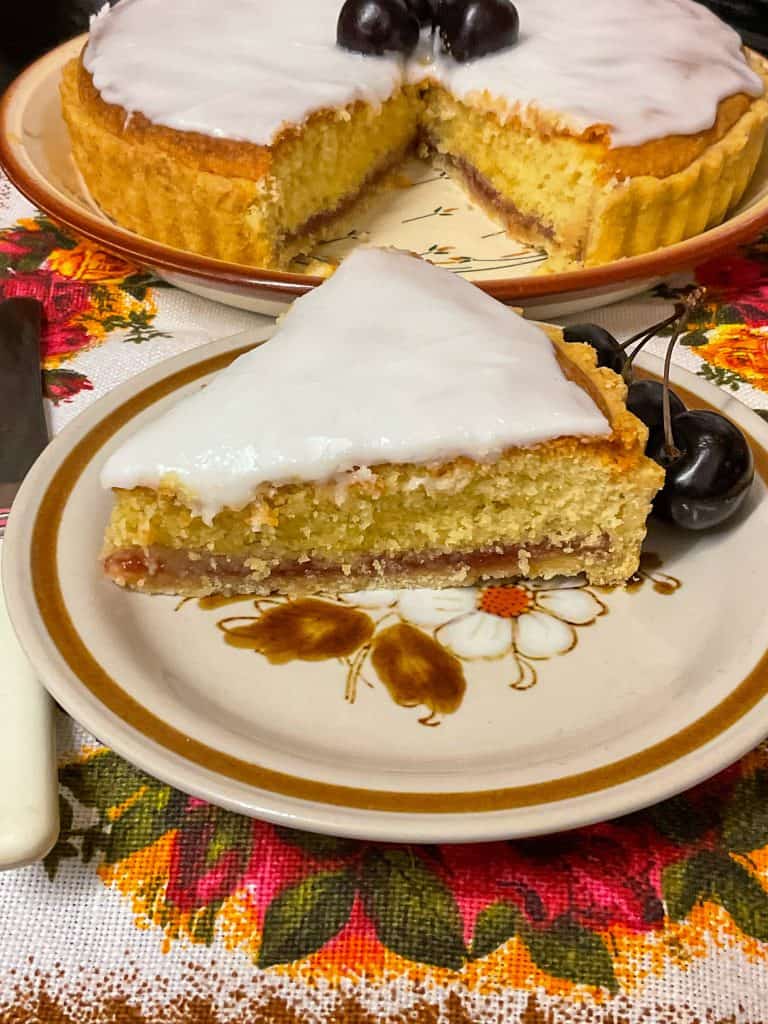
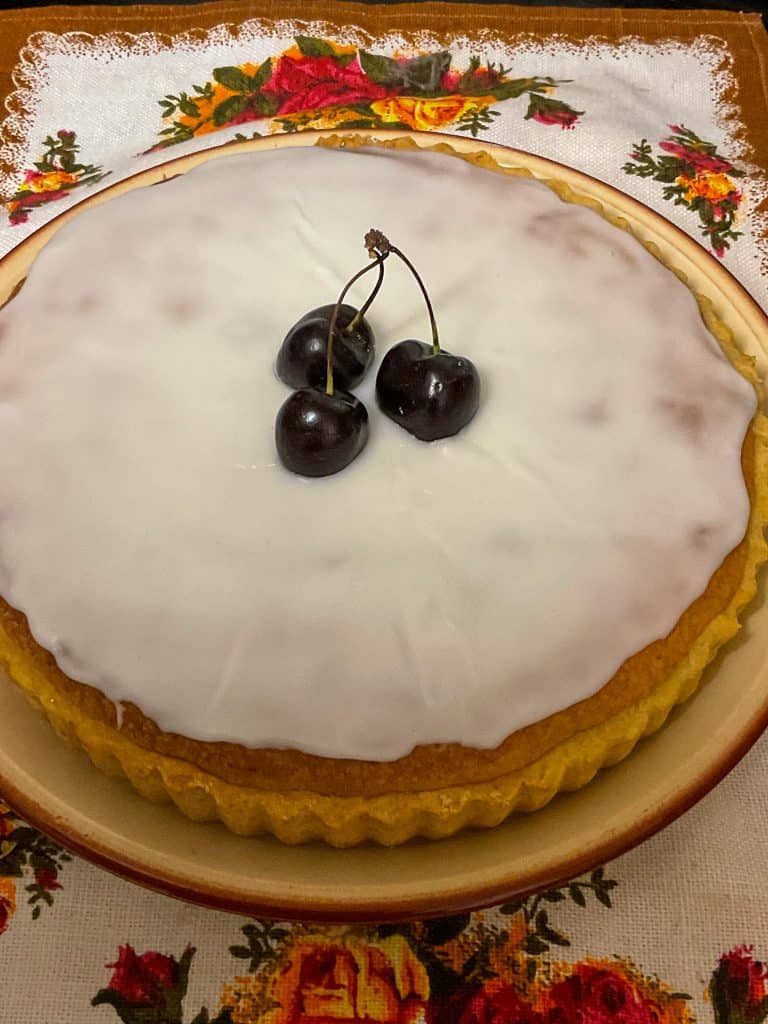
This is a nice & easy Old English recipe for Bakewell tart, which doesn’t require any ground almonds. The shortcrust pastry is crisp and buttery, while the sponge filling is soft, fluffy, with classic frangipane flavours, and the topping is a simple glace icing.
The Cookery of England Book
This recipe for Bakewell Tart comes from my copy of Elizabeth Ayrton’s cookery book ‘The Cookery of England – being a Collection of Recipes for Traditional Dishes of All Kinds from the Fifteenth Century to the Present Day, with Notes on their Social and Culinary Background’ (1984). The first edition of this book was published in 1974. The Bakewell Tart recipe can be found on page 449. For the shortcrust pastry, I adapted Aryton’s shortcrust pastry recipe by halving the ingredient amounts, reducing the liquid called for, and adding sugar and salt. Ayrton’s original shortcrust pastry recipe can be found on page 93.
I have made a few changes to the recipe but none that take away from the essence of the original recipe. For example, I felt that the quantities given would not be enough to fill my flan dish, so I doubled the recipe, i.e. instead of 1 egg I used 2, instead of 60 grams of flour I used 120 grams. Also, I added almond extract as the recipe did not include it, and I wanted the sponge to have that classic almond bakewell flavour.
In her book Aryton describes the origins of the Bakewell Tart:
”The Bakewell tart came originally from Bakewell in Derbyshire. Some early nineteenth-century recipes suggest using half flour and half ground almonds, which makes a richer mixture. The tart was intended for high tea and is in fact a cross between a cake and a pudding” (pg449).
Ayrton’s recipe is a nut-free one but as suggested above you can use half flour and half ground almonds. Also Aryton states that the pastry used can be either shortcrust or ruff puff pastry so although the recipe below provides a shortcrust pastry method you can choose to use a ruff puff pastry instead.
More modern Bakewell tarts commonly feature a sprinkle of flaked almonds over the tart before it is baked, and a glace cherry garnish on top of the icing, so if liked you can add those. I had some fresh cherries so I thought those would accompany the Bakewell tart nicely.
Bite of bakewell tart history
The first Bakewell tart wasn’t considered a tart as it was more of a pudding. According to local legend, the original Bakewell pudding was created by mistake around 1820–1825, when a cook at the White Horse Inn (later known as the Rutland Arms) misread instructions and spread an egg and sugar mixture over a layer of jam and pastry instead of mixing it in. The result was so well-received that it became a local favourite.
The earliest written recipes for Bakewell pudding appear in the 1840s, with variations in 19th-century cookbooks such as those by Eliza Acton and later Mrs Beeton. These versions used a puff pastry base with an egg and almond custard filling often baked without a pastry lid.
The Bakewell tart as we know it today, which features a shortcrust pastry base, a layer of jam, and a sponge-like almond frangipane topping, was developed later in the 20th century. Some sources suggest it may have first appeared in print in the early 1900s, but it became especially popular post-WWII as a classic British teatime treat.
For more old English dessert tart recipes have a good look through our constantly growing collection of British dessert tarts & pie recipes. We have recipes in the collection that date back to the Stuart Era (1603-1714) through to the Edwardian Era (1901-1910) and the Early Modern Era.
This is a nice & easy Old English recipe for Bakewell tart, which doesn't require any ground almonds. The shortcrust pastry is crisp and buttery, while the sponge filling is soft, fluffy, with classic frangipane flavours, and the topping is a simple glace icing.
Course Dessert
Cuisine British
Keyword Bakewell Tart, English recipes, Historical recipes, traditional recipes, Vintage recipes
Prep Time 30 minutesminutes
Cook Time 35 minutesminutes
Pastry chilling time 30 minutesminutes
Total Time 1 hourhour35 minutesminutes
Servings 8slices
Calories 547kcal
Author Leigh
Equipment
8-9 inch [20-22cm] tart, pie or flan dish, or an enamel plate suitable for baking preferably one with a removable bottom plate for ease of removing baked tart
mixing bowl
mixing spoon or electric hand whisk
metal cutlery knife
Rolling Pin
small bowl
wire rack
sieve
Ingredients
Shortcrust pastry
228gramsplain flour[8oz]
120gramsbutter or baking margarine[4oz]
30gramsgranulated sugar[1oz]
pinchsalt
4tablespoonswateruse more if required
Filling
6tablespoons strawberry fruit jam
2mediumeggs[Each egg in the shell weighs about 60grams [2oz])
120gramsself-raising flour[4oz]
120gramsbutter or baking margarine[4oz]
120gramsgranulated sugaror caster sugar [4oz]
2teaspoonsalmond extract
Glace icing topping
165gramsicing sugar[6oz]
1teaspoonalmond extract
5teaspoonswater
Instructions
Prepare pastry
Add the flour, butter in small pieces, salt and sugar to a mixing bowl.
228 grams plain flour, 120 grams butter or baking margarine, 30 grams granulated sugar, pinch salt
Using your fingertips, rub the butter into the ingredients until it resembles fine breadcrumbs.
4 tablespoons water
Add the water and, using a metal cutlery knife or similar utensil, cut through the ingredients, mixing the water in. It may take a minute or so of mixing, but the mixture will start clumping and coming together.
Using floured hands, bring the pastry together into a smooth ball. If the mixture is too dry, incorporate a few more drops of water. If the mixture is too damp rub in some more flour.
Chill the pastry in the fridge for at least 30 minutes.
Set the oven to moderate heat: 350°F, or 180°C (160°C for fan ovens), Gas Mark 4.
Line flan dish with pastry
Grease the flan dish with butter or margarine.
Sprinkle flour over your work table and rolling pin. Roll out the pastry until it's about ¼ inch thick. Wrap the pastry around the rolling pin and line the flan dish. Gently press the pastry down into the dish and around the sides.
Using a cutlery knife, trim the pastry around the edges.
Spread the fruit jam evenly over the pastry bottom.
6 tablespoons strawberry fruit jam
Prepare the filling
Add the butter and sugar to a mixing bowl.
120 grams butter or baking margarine, 120 grams granulated sugar
Using either an electric hand whisk or a mixing spoon, cream the butter and sugar together.
Measure out the flour into a separate smaller bowl.
120 grams self-raising flour
Add the eggs and almond extract to the creamed ingredients.
2 medium eggs, 2 teaspoons almond extract
Add some of the flour and mix well, adding more flour in stages until it is used up. Adding the flour this way to the eggs can help prevent the mixture from splitting. If the mix does split don't worry as it will be fine once baked.
Cover the jam with the mixture, spreading out the surface evenly across the pastry case.
Bake
Place on the middle shelf of the oven and bake for 30-35 minutes or until the filling is golden and well risen. A skewer popped in the middle will come out clean.
Cool on a wire rack before adding the glace icing.
Prepare glace icing
Carefully remove the bakewell tart from the flan dish.
Sift the icing sugar into a mixing bowl.
165 grams icing sugar
Pour in the water and almond extract.
1 teaspoon almond extract, 5 teaspoons water
Mix together until it forms a thick spreadable paste. If it becomes too runny, mix in extra icing sugar, and if it is too thick to spread, add small drops of water.
Spread the mixture evenly over the tart using the back of a cutlery spoon or a cutlery knife.
Allow the icing to set firm before slicing. To speed up the icing setting, you can pop the flan into the fridge for about 30 minutes or so.
Notes
Calorie calculation is based on 8 good-sized slices of Bakewell tart. Smaller slices will yield fewer calories.
Variations: Sprinkle flaked almonds over the tart before baking, or sprinkle toasted almond flakes over the glace icing topping.
Decorate the glace icing with cake sprinkles, or glace [candied] cherries or fresh cherries, or other berries.
Replace the almond extract with vanilla.
Use half flour and half ground almonds for the filling.
Instead of spreading the glace icing over the top of the baked tart, you can drizzle it over to form a squiggly pattern.
Storing: At Room Temperature: If your kitchen isn’t too warm, Bakewell tart can be kept in an airtight container at room temperature for up to 2–3 days. Just make sure it’s fully cooled before storing to avoid condensation making the pastry soggy. In the Fridge: To keep it fresher for a bit longer, pop it in the fridge in a sealed container or cover it well with reusable wrap. It’ll keep for around 4–5 days refrigerated.
I would love to hear from you if you have baked this Bakewell tart recipe. Do leave us a comment below. We have many more old British recipes for dessert pies, tarts and flans over on our main collection page.
We use cookies to ensure that we give you the best experience on our website. If you continue to use this site we will assume that you are happy with it.